Introduction: The Strange Healing Chamber That Promised to Restore Human Energy
Imagine living in the 1800s, when modern medicine was still developing and mysterious illnesses could leave families desperate for answers.
Now imagine hearing about an unusual treatment: a large pyramid made from copper, inside which a sick person could sit and supposedly regain their strength.
The idea sounds like something from a forgotten science-fiction novel. Yet images and stories about copper pyramids, mysterious energies, and unconventional healing methods continue circulating online today.
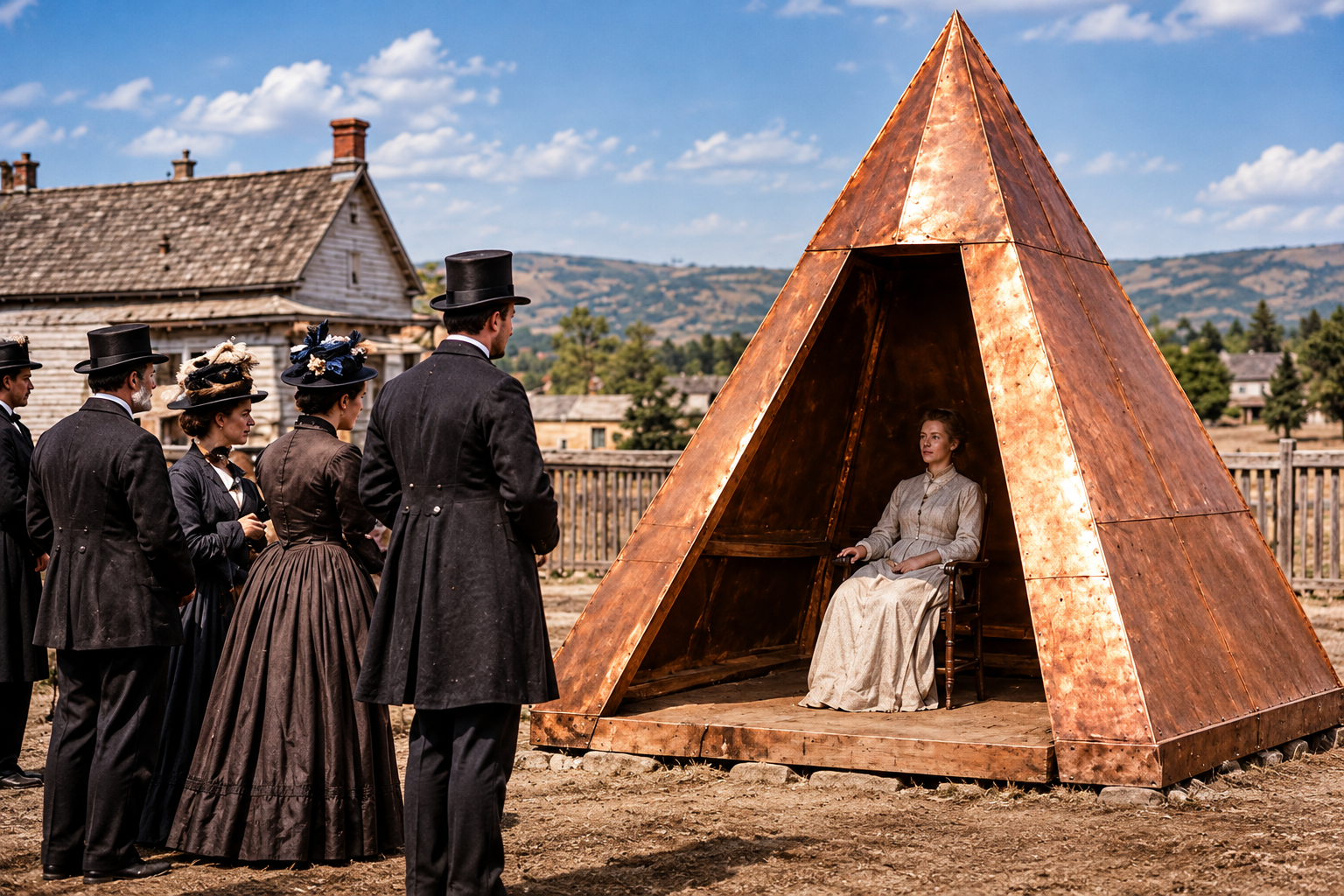
One particularly striking image shows a woman sitting inside a towering copper pyramid while Victorian-era spectators watch.
According to the accompanying claim, people in the 1800s used copper pyramids to improve the body’s electrical charge and recover from illness.
But did these remarkable healing chambers really exist? And could copper have the extraordinary effects attributed to it?
The answer takes us into a fascinating world of Victorian scientific experimentation, electrical medicine, ancient symbolism, and the enduring human desire to discover miraculous cures.
Important historical note: There is no reliable evidence establishing that sitting inside copper pyramids was a recognised medical treatment in the 1800s, or that such structures could cure illness by increasing a person’s electrical charge. The image should be treated as an illustration of an unverified claim, not historical proof.
1. A Mysterious Pyramid in a Victorian Village
Picture a quiet village in the late nineteenth century.
Horse-drawn carriages pass along narrow streets. Men wear tall hats and dark coats, while women walk beneath elaborate bonnets.
At the edge of the village stands an unusual structure.
It isn’t a church, a greenhouse, or a monument.
It is a tall copper pyramid, large enough for a person to sit inside.
In this imagined scene, a local inventor has invited villagers to witness an experiment.
He believes the pyramid’s unusual shape and metallic walls might influence invisible natural forces.
Inside sits a woman who has been suffering from exhaustion.
The inventor assures the spectators that the copper structure will help restore her vitality.
As the afternoon passes, the crowd waits for something extraordinary.
But what exactly is supposed to happen?
This fictional scene captures the mystery behind modern stories about copper pyramid healing, although it is not evidence that such an experiment occurred.
2. Why Copper Seemed So Mysterious
Copper has fascinated human societies for thousands of years.
It was among the earliest metals used by ancient civilisations and became essential for tools, ornaments, coins, and eventually electrical equipment.
By the nineteenth century, researchers understood that copper was an excellent conductor of electricity.
That discovery made copper particularly important during a period of rapid scientific and technological development.
Electrical communication, industrial machinery, and experiments involving batteries and electromagnetic phenomena were transforming everyday life.
To people unfamiliar with the science, electricity could appear almost magical.
If invisible electrical forces could power new inventions, some wondered whether those forces might also influence the human body.
This curiosity helped inspire various electrical and magnetic health treatments.
However, copper’s ability to conduct electricity does not mean a copper enclosure can automatically improve health or supply beneficial electrical energy to a person sitting inside it.
3. The Victorian Obsession With Electricity and Healing
The nineteenth century was an exciting but confusing period for medical innovation.
Scientists were making genuine discoveries about anatomy, infection, electricity, and human physiology.
At the same time, unproven therapies were frequently promoted alongside legitimate treatments.
One example was electrotherapy, in which electrical currents were applied to the body for various medical purposes.
Some electrical techniques eventually developed into evidence-based medical applications.
Others were marketed with exaggerated promises.
Electrical belts, magnetic devices, and other unusual products were advertised as ways to restore strength or treat a wide variety of ailments.
The language used in these advertisements often sounded impressive.
Words such as vitality, magnetism, nervous energy, and electrical balance appealed to people searching for relief.
Yet many of these products lacked convincing scientific evidence.
The copper pyramid story fits naturally into this broader atmosphere of experimentation and extraordinary health claims, even though its alleged nineteenth-century use remains unverified.
4. Why the Pyramid Shape Captured People’s Imaginations
Pyramids have inspired fascination for centuries.
Their enormous scale, geometric precision, and association with ancient civilisations have encouraged countless theories about hidden knowledge and mysterious forces.
The Egyptian pyramids, in particular, became symbols of antiquity and human ingenuity.
During the nineteenth century, European interest in ancient Egypt grew through archaeological discoveries, museum collections, travel writing, and popular culture.
Pyramid shapes appeared in architecture, monuments, decorative objects, and imaginative literature.
Over time, some writers began attributing unusual powers to pyramid geometry.
These claims later developed into ideas often described as pyramid energy or pyramid power.
Supporters have suggested that pyramid-shaped structures might preserve objects, influence biological processes, or concentrate mysterious forces.
But controlled scientific evidence has not established that a pyramid’s shape provides special healing properties.
The geometric appearance may be impressive, but appearance alone does not demonstrate medical effectiveness.
5. The Woman Inside the Copper Pyramid
Return to our imagined Victorian village.
The woman inside the pyramid sits quietly in a wooden chair.
Sunlight reflects from the reddish metal walls.
Outside, spectators whisper about what might be happening.
One man believes the structure will strengthen her nerves.
Another thinks the pyramid is collecting natural electricity.
A third wonders whether the shape itself possesses an ancient secret.
After some time, the woman steps outside.
She says she feels calmer.
The inventor smiles, and the crowd becomes excited.
But has the pyramid healed her?
Not necessarily.
Resting quietly, escaping daily stress, receiving attention, and expecting improvement can all influence how someone feels.
A person may experience temporary relief without the proposed treatment being responsible.
This is one reason medical research relies on careful testing rather than individual testimonials alone.
The story illustrates how easily a sincere personal experience can become the foundation of an extraordinary claim.
6. Can Copper Really Change the Body’s Electrical Charge?
The human body uses electrical signals.
Nerve cells communicate through changes in electrical potential, and the heart’s electrical activity can be measured using an electrocardiogram.
These processes are essential to normal physiology.
Copper also plays a legitimate biological role as a trace mineral required for several enzymes and bodily functions.
However, these facts do not support the claim that sitting inside a copper pyramid can enhance a person’s health by increasing their electrical charge.
Electrical conductivity is a physical property of the metal.
It does not establish that a passive copper structure can generate therapeutic energy.
Nor is there a recognised medical measurement showing that such an enclosure restores a sick person’s overall electrical charge.
Copper-containing medical materials and electrical medical devices must be evaluated for their specific mechanisms and effects.
Those legitimate applications should not be confused with unproven pyramid-healing claims.
7. The Problem With Miracle Cures in the 1800s
Medical care during the nineteenth century varied greatly in quality and effectiveness.
Many infectious diseases remained dangerous, and important modern treatments were unavailable.
Families sometimes turned to travelling healers, patent medicines, electrical gadgets, and unconventional therapies.
Some treatments were harmless but ineffective.
Others were actively dangerous.
Advertisements could promise dramatic recoveries without providing reliable evidence.
A persuasive inventor, an impressive-looking machine, and a few enthusiastic testimonials were sometimes enough to attract paying customers.
That history offers an important lesson.
Scientific-sounding language does not automatically make a treatment scientific.
Claims require careful evidence, especially when someone’s health is at stake.
8. Why Old Photographs Can Be Misleading
The copper pyramid image is particularly convincing because it appears to show an old-fashioned scene.
The clothing resembles Victorian fashion.
The surrounding buildings suggest an earlier historical period.
The copper structure looks weathered and substantial.
Together, these details create the impression of a forgotten historical event.
But an image cannot establish when something happened, what a structure was used for, or whether an accompanying explanation is accurate.
Modern illustrations, staged photographs, digital composites, and AI-generated images can all depict events that never occurred.
Before accepting a remarkable historical claim, it is worth asking several questions.
Where did the image originate? Is there a dated archive record? Was the device described in contemporary newspapers, medical journals, patents, or scientific publications? Can independent sources verify the story?
Without that evidence, the most responsible conclusion is that the claim remains unverified.
9. The Difference Between Scientific Discovery and Scientific Myth
Some of the most important medical advances began with ideas that seemed strange.
Electricity, X-rays, anaesthesia, and microbiology all changed how people understood the human body.
But successful scientific discoveries were not accepted simply because they sounded exciting.
Researchers developed explanations, tested predictions, examined results, and refined their understanding.
The same standards should apply to copper pyramid healing.
If a structure genuinely produced a measurable medical benefit, researchers would need to demonstrate that benefit through reliable experiments.
They would also need to identify the conditions under which the effect occurred and determine whether it was safe.
Until such evidence exists, the claim should not be presented as an established treatment.
10. Why People Still Believe in Mysterious Healing Energy
Stories about hidden energies remain appealing because they offer something emotionally powerful: hope.
When someone is ill, frightened, or disappointed by unsuccessful treatments, a simple explanation and a promise of relief can be deeply attractive.
A mysterious copper pyramid may seem more exciting than an ordinary medical appointment.
Its connection to ancient geometry and electrical science gives the story an additional sense of wonder.
But hope and evidence are not the same thing.
People deserve compassionate care, accurate information, and treatments supported by appropriate research.
Curiosity about unusual historical ideas can coexist with a healthy respect for modern scientific standards.
11. What This Mystery Tells Us About Human Nature
The copper pyramid story reveals something that reaches far beyond Victorian medicine.
Human beings have always searched for ways to understand suffering.
When faced with illness, uncertainty, or fear, we look for patterns and explanations.
Sometimes that search leads to genuine discoveries.
Sometimes it produces myths that survive for generations.
The most fascinating part of the copper pyramid legend may not be the metal or the geometry.
It may be the fact that people continue to share the story because they want to believe that extraordinary solutions are still waiting to be discovered.
That curiosity is valuable.
But it becomes most useful when paired with careful investigation.
12. The Forgotten Inventor: An Imagined Ending
In our fictional Victorian village, the copper pyramid remains standing for several months.
Visitors arrive from neighbouring towns.
Some claim they feel better after sitting inside.
Others notice no difference.
Eventually, interest fades.
The inventor moves on to another project, and the structure is dismantled.
Years pass.
The village changes.
The copper sheets are reused, the wooden chair disappears, and the story survives only as a local rumour.
Decades later, someone discovers an old drawing of the strange chamber.
A new generation sees it and asks the same question:
Could this mysterious pyramid really have healed people?
The answer remains hidden—not because a powerful secret has necessarily been lost, but because a compelling story is not the same as documented evidence.
Final Thoughts: The Truth Is More Interesting Than the Myth
The idea of sick people sitting inside copper pyramids during the 1800s is undeniably fascinating.
It combines the visual mystery of ancient geometry with the excitement of early electrical science and the desperation of people searching for medical relief.
Yet there is no reliable evidence that copper pyramid chambers were a recognised nineteenth-century healing practice, and no established scientific basis for claims that they restore health by enhancing the body’s electrical charge.
What we can say is that the Victorian era saw genuine experimentation with electricity, widespread interest in unconventional therapies, and a growing fascination with technologies that seemed capable of changing human life.
That real history is remarkable enough without inventing medical miracles.
Perhaps the most valuable lesson is not that our ancestors possessed a forgotten cure.
It is that every generation must learn to distinguish an extraordinary claim from an extraordinary discovery.
Would you have believed the inventor if you had lived in the 1800s and seen a mysterious copper pyramid standing in your village?