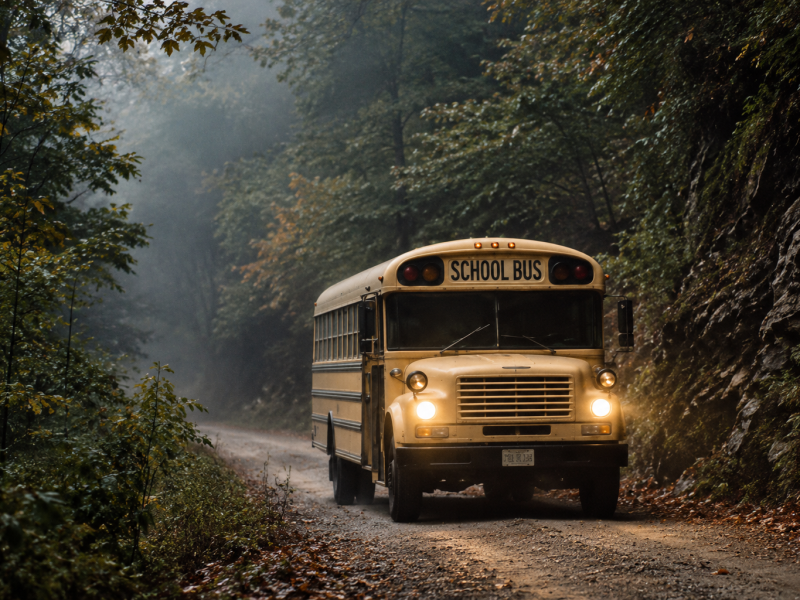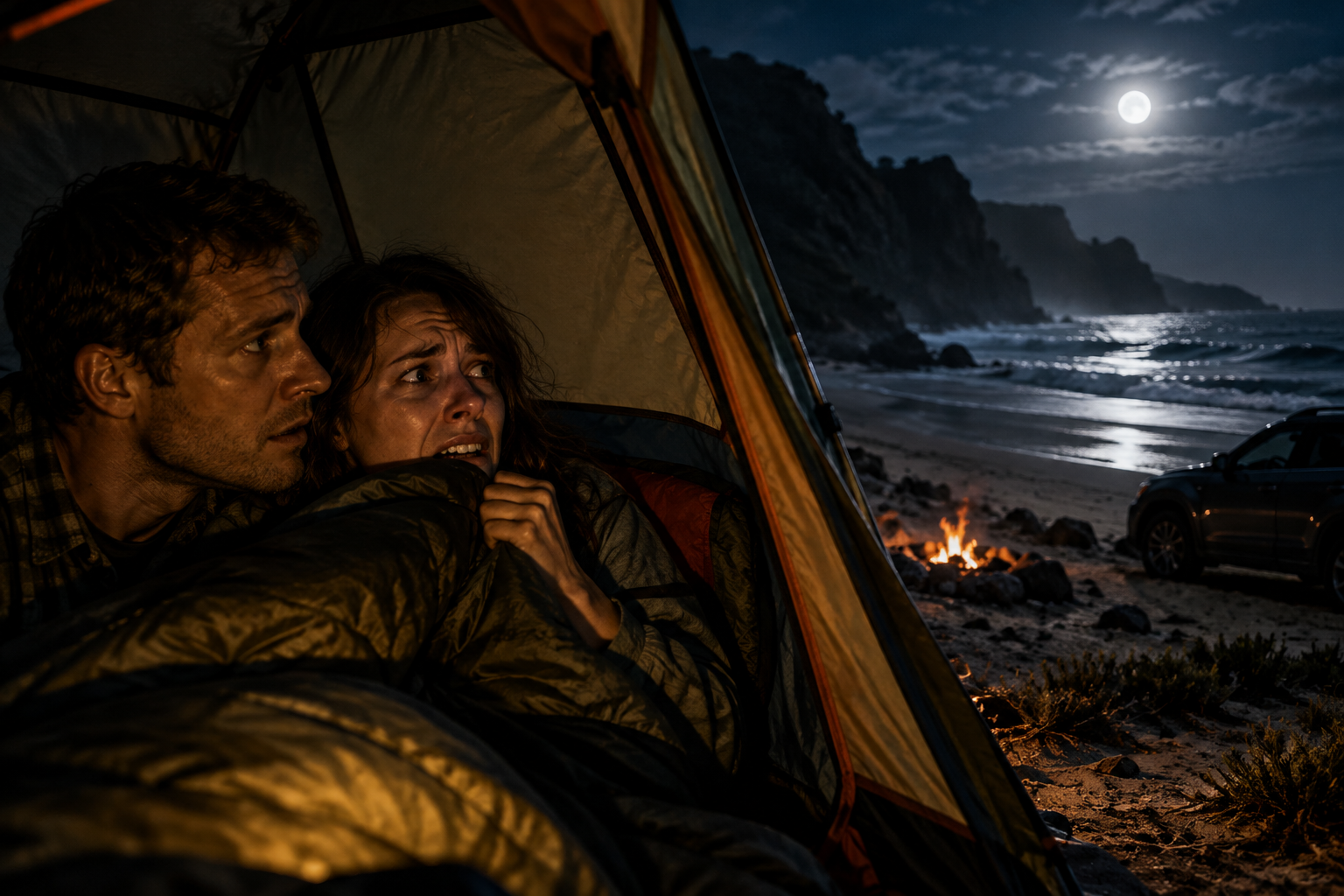
An original fictional camping horror story about a couple’s road trip, an isolated California beach, and the terrifying feeling that someone—or something—was watching them.
The Road Trip That Was Supposed to Be Perfect
I’ve always loved road trips.
There’s something about driving along an unfamiliar highway with the windows down, music playing, and absolutely no plans that makes life feel simple.
Last summer, my girlfriend, Emily, and I decided to take a week off work and drive along the California coast.
We weren’t interested in expensive hotels or crowded tourist attractions. We wanted quiet beaches, beautiful sunsets, and a few nights sleeping under the stars.
For the first three days, everything went perfectly.
We explored little coastal towns, ate at roadside diners, and stopped whenever we saw something interesting.
But on the fourth evening, we made a decision that I still regret.
We decided to camp on a beach that wasn’t marked on any of the tourist maps.
And I wish we’d never found it.
1. The Beach That Nobody Mentioned
It was almost 7 p.m. when we realized we had nowhere to sleep.
The nearest campground was more than an hour away, and both of us were exhausted.
Emily was scrolling through a map on her phone when she noticed a narrow road leading toward the ocean.
“Look,” she said. “There’s a beach down here. Maybe we can find somewhere to stay.”
The road was barely visible on the map.
There were no reviews, no photographs, and no information about facilities.
We drove along a winding dirt track surrounded by tall grass and dark trees until the ocean finally appeared.
The beach was beautiful.
Golden sand stretched between two enormous cliffs. Waves rolled gently toward the shore, and the setting sun painted the water orange.
But something felt strange.
There were no footprints.
No parked cars.
No fishing boats.
Not even a single piece of litter.
It looked as though nobody had visited the place in years.
“Perfect,” Emily whispered.
I smiled, but I didn’t feel the same excitement.
Something about the beach made me uncomfortable.
I couldn’t explain why.
2. The First Warning
We parked beside the cliffs and carried our camping equipment onto the sand.
As I was setting up the tent, I noticed something half-buried near a large rock.
It was an old wooden sign.
Most of the paint had disappeared, but I could still make out a few words.
NO OVERNIGHT ACCESS
Below that, another line had been scratched away.
I showed Emily.
“Maybe it’s an old restriction,” she said. “We should probably check.”
We tried searching online, but neither of our phones had a signal.
I looked back toward the dirt road.
It was already getting dark.
“We should leave,” I said.
Emily looked disappointed.
“Are you serious? We’ve just finished setting everything up.”
I hesitated.
The road had been difficult to navigate in daylight. Driving back in darkness didn’t sound appealing.
“One night,” I finally said. “We’ll leave first thing in the morning.”
That was my second mistake.
The first was coming there at all.
3. The Silence After Sunset
At first, everything seemed normal.
We ate sandwiches, watched the last light disappear over the ocean, and climbed into our sleeping bags.
The waves were surprisingly quiet.
I remember lying on my back, staring at the ceiling of the tent.
“Can you hear that?” I asked.
Emily listened.
“Hear what?”
“Exactly.”
She laughed.
But I wasn’t joking.
The ocean had become almost completely silent.
Earlier, waves had been crashing against the shore every few seconds.
Now I could barely hear them.
There was no wind.
No insects.
No distant traffic.
Nothing.
It was the kind of silence that makes you suddenly aware of your own breathing.
I checked my watch.
10:43 p.m.
Then something moved outside.
4. Footsteps Around the Tent
At first, I thought it was an animal.
The sound came from somewhere behind our tent.
A soft crunch.
Then another.
Then another.
Footsteps.
Slow and deliberate.
I sat upright.
Emily turned toward me.
“What is it?”
I raised a finger to my lips.
The footsteps continued.
They moved from the back of the tent toward the entrance.
Then stopped.
I waited for someone to speak.
Nobody did.
“Hello?” I called.
No answer.
“Is somebody there?”
Still nothing.
After several seconds, the footsteps started again.
This time, they moved away from the tent.
Emily grabbed my arm.
“Please tell me that’s just someone walking on the beach.”
I wanted to believe it.
But there was something wrong with the sound.
Whoever was outside seemed to be walking in a perfect circle around us.
5. The Light on the Cliff
I unzipped the tent just enough to look outside.
The beach was empty.
Moonlight reflected off the water.
Our car sat near the cliffs, exactly where we’d left it.
There was nobody around.
Then I noticed a light.
High above us, near the edge of the cliff, a small white glow appeared between the trees.
It moved slowly from left to right.
Then stopped.
It looked like someone holding a flashlight.
I stared at it.
The light went out.
A few seconds later, it appeared again.
This time, closer to the path leading down to the beach.
“Emily,” I whispered, “I think someone is watching us.”
She crawled toward the entrance.
The moment she looked outside, the light disappeared.
We sat there in silence.
Then her phone vibrated.
Both of us jumped.
It was a notification from a map application that had been trying to load.
A small section of the coastline appeared on her screen.
And beside the beach, there was a label.
Restricted Coastal Access — Unstable Cliffs
My stomach dropped.
We weren’t supposed to be there.
6. The Voice Outside
“We’re leaving,” I said.
Emily didn’t argue.
We started stuffing our belongings into our bags.
I was folding my sleeping bag when I heard something outside the tent.
A voice.
“Excuse me.”
It was a man’s voice.
Quiet.
Almost polite.
I froze.
“Excuse me,” the voice repeated.
It sounded as though the speaker was standing just inches from the tent entrance.
“Can you help me?”
Emily stared at me.
I swallowed.
“Who’s there?”
No answer.
Then the voice spoke again.
“Please come outside.”
Something about those words made every muscle in my body tighten.
The voice didn’t sound angry.
It didn’t sound frightened.
It sounded rehearsed.
Like someone repeating a sentence they’d practiced many times.
I reached for the small flashlight beside my bag.
“Who are you?” I shouted.
The answer came immediately.
“I’m lost.”
I looked at Emily.
Her eyes were filled with tears.
Because the voice had come from directly outside the entrance.
But there was no shadow against the tent.
No movement.
Nothing.
7. The Footprints That Didn’t Make Sense
I knew we couldn’t stay inside forever.
Our car was only about fifty yards away.
If we could reach it, we could drive back to the highway.
I told Emily to put on her shoes and grab only what she could carry.
Then I unzipped the tent.
The beach was empty.
Nobody stood outside.
I shone my flashlight across the sand.
That’s when I saw the footprints.
They circled our tent.
One complete ring.
Then another.
Then another.
But the strangest part was where they ended.
The footprints stopped directly in front of our tent entrance.
There were no tracks leading away.
I stared at the sand, trying to understand what I was seeing.
“Don’t look,” I told Emily.
But she already had.
“Oh my God,” she whispered.
I grabbed her hand.
“Run.”
8. Someone Was Sitting in Our Car
We sprinted across the beach.
Sand filled my shoes.
My lungs burned.
I kept expecting to hear footsteps behind us, but there was nothing.
We reached the car.
I pressed the unlock button.
The headlights flashed.
Then Emily screamed.
Someone was sitting in the back seat.
I saw the shape clearly through the window.
A dark figure.
Motionless.
Its head seemed to be turned toward us.
I stumbled backward.
My flashlight slipped from my hand.
The figure didn’t move.
Then I blinked.
And it was gone.
The back seat was empty.
I don’t know whether it was a reflection, a trick of the shadows, or something else.
I only know that both of us saw it.
“Get in!” I shouted.
Emily climbed into the passenger seat.
I started the engine.
For one terrible second, nothing happened.
Then the engine turned over.
I slammed the car into reverse.
9. The Man Beside the Road
We drove up the narrow dirt track as quickly as I dared.
Branches scraped against the windows.
The headlights bounced across rocks and uneven ground.
Neither of us spoke.
About five minutes later, the road curved sharply through a grove of trees.
And there he was.
A man standing beside the road.
He wore a dark jacket and had his hands at his sides.
His face was hidden in shadow.
I slowed instinctively.
Then he raised one hand.
Not to wave.
Not to signal for help.
He pointed back toward the beach.
Emily whispered, “Don’t stop.”
I pressed the accelerator.
As we passed him, I glanced in the rearview mirror.
He hadn’t moved.
He was still pointing toward the ocean.
Then the road turned, and he disappeared from view.
10. What We Discovered the Next Morning
We reached a motel shortly after midnight.
Neither of us slept much.
In the morning, I told the receptionist where we’d been.
She stopped typing.
“Which beach?”
I described the dirt road, the cliffs, and the isolated stretch of sand.
Her expression changed.
“You shouldn’t have gone down there.”
I felt cold.
“Why?”
She explained that the access road had been closed because parts of the cliff were unstable and the area had no emergency facilities.
A few years earlier, a serious nighttime rescue had taken place there after visitors became stranded.
Since then, locals had generally avoided the beach after dark.
I asked about the man we’d seen.
She shook her head.
“Could’ve been anyone. People still go down there sometimes.”
Then she looked at me carefully.
“Did somebody approach your tent?”
I nodded.
She didn’t seem surprised.
“That beach is isolated. If someone was bothering you, you did the right thing leaving.”
I wanted to ask more.
But Emily squeezed my hand under the counter.
She wanted to go.
So we did.
11. The Photograph We Couldn’t Explain
We were halfway home when Emily remembered something.
Before going to sleep, she’d taken several photographs of our campsite.
She opened her phone and began scrolling.
The first photograph showed the sunset.
The second showed our tent beside the ocean.
The third showed me standing near the car.
Then she stopped.
“Look at this.”
I glanced at the screen.
It was another photograph of our tent, taken just before sunset.
Behind us, near the cliff path, stood a person.
A man in a dark jacket.
His face was turned toward the camera.
I felt my stomach tighten.
Neither of us remembered seeing him.
But that wasn’t the worst part.
When Emily zoomed in, we noticed something in his hand.
A flashlight.
The same kind of white light we’d seen moving along the cliff hours later.
I pulled into a petrol station and stared at the photograph.
For several minutes, neither of us said anything.
Finally, Emily whispered:
“He was there before it got dark.”
And suddenly, the entire night felt different.
12. Why I Never Ignore That Feeling Anymore
It’s been almost a year since that trip.
I still don’t know who the man was.
Maybe he was a local who wanted to scare away trespassers.
Maybe he was someone looking for an opportunity to frighten two strangers.
Maybe the figure in our car was only a reflection.
And maybe the strange footprints had an ordinary explanation we were too frightened to notice.
I don’t know.
But I know this.
Something felt wrong from the moment we arrived.
The empty beach.
The damaged warning sign.
The silence after sunset.
The footsteps.
The voice outside the tent.
Every instinct told me to leave.
And I ignored those warnings because the beach looked beautiful and we were tired.
People sometimes ask whether I believe the place was haunted.
I don’t have an answer.
What frightens me more is the possibility that everything we experienced was entirely human.
That someone watched us arrive.
Waited until darkness.
And then tried to persuade us to come outside.
I still have the photograph.
I haven’t deleted it.
But I don’t look at it anymore.
Because whenever I do, I remember the man’s hand pointing toward the beach.
And I wonder what would have happened if we’d listened to that quiet voice outside our tent.
“Please come outside.”
Final Thoughts: Sometimes Fear Is a Warning
Not every frightening feeling means something dangerous is happening.
But when you’re in an unfamiliar, isolated place, it’s important to pay attention to your surroundings, respect warning signs, and leave when a situation becomes unsafe.
A beautiful location isn’t automatically a safe place to camp.
And an empty beach isn’t necessarily an invitation to stay.
The scariest part of that night wasn’t what we saw. It was realizing how many chances we’d had to leave before things became terrifying.
Sometimes, the most important lesson from a frightening experience is also the simplest:
Trust your instincts, take warning signs seriously, and never let curiosity become more important than your safety.