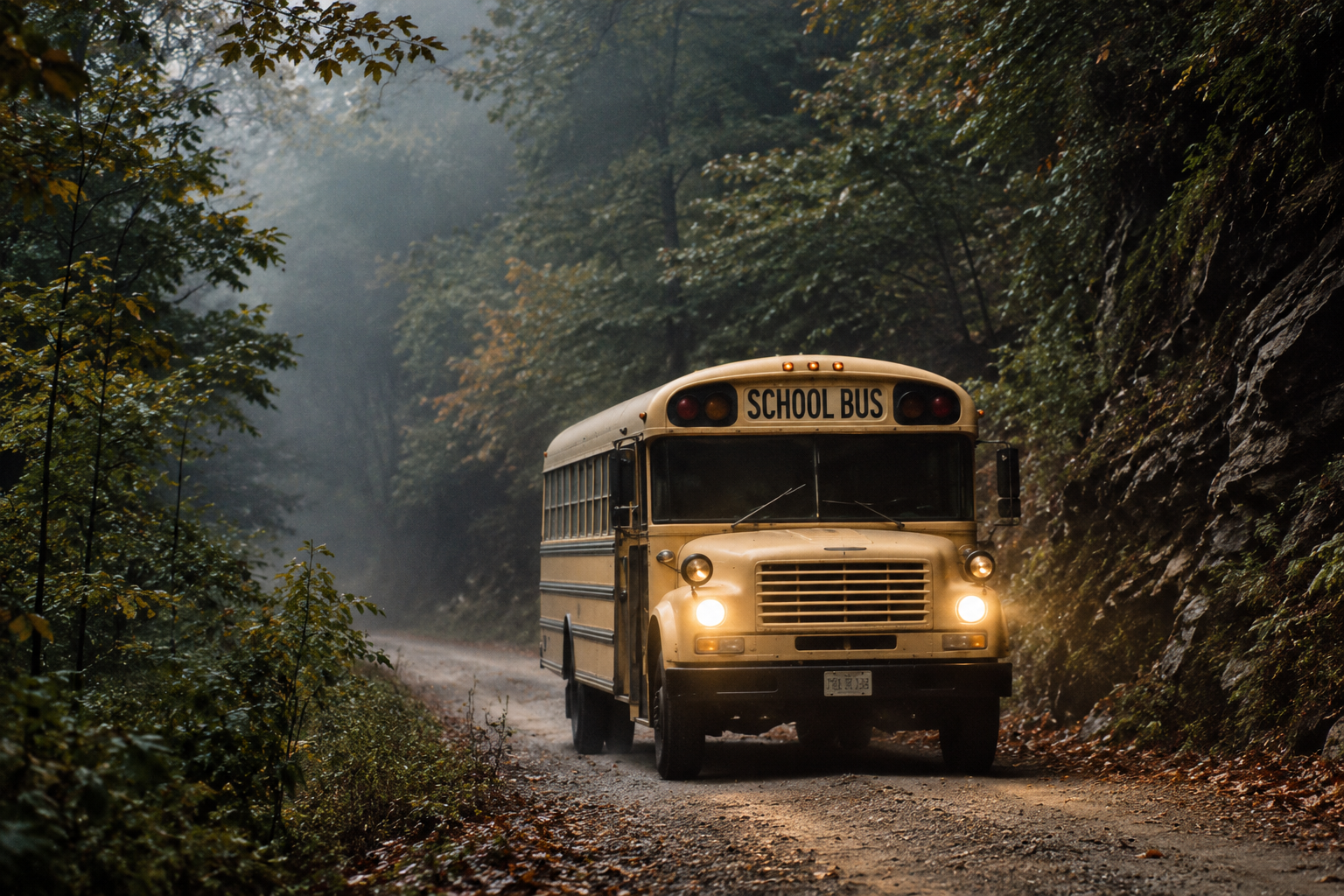
An original fictional horror story inspired by the legend of a mysterious school bus, a forgotten mountain road, and headlights that still appear in the darkness.
The Morning the School Bus Disappeared
In the autumn of 1968, the small mountain town of Black Hollow, Kentucky, was a place where everybody knew everybody.
Families lived in modest wooden houses scattered across the hills. Narrow roads wound through dense forests, and the sound of school buses climbing the mountains was as familiar as the morning church bells.
But one cold October morning, something happened that would change the town forever.
A yellow school bus carrying twelve students disappeared without a trace.
The driver was a quiet, dependable man named Walter Briggs. He had driven the same route for almost fifteen years.
Every morning, he collected children from the remote mountain communities and brought them safely to Black Hollow Elementary School.
He was never late.
He never missed a stop.
And he never took unfamiliar roads.
But on October 17, 1968, Walter and his passengers never arrived.
At first, the school assumed the bus had broken down.
By noon, worried parents began calling.
By sunset, the sheriff had organized a search.
And by midnight, the entire town was asking the same terrifying question.
How could a full-sized school bus disappear on a road with nowhere to hide?
1. The Last Person Who Saw the Bus
The last confirmed sighting came from an elderly farmer named Samuel Price.
Samuel lived near the edge of the forest, approximately five miles from the school.
That morning, he had been repairing a fence when he heard the familiar rumble of the approaching bus.
He looked up and saw Walter driving slowly along the mountain road.
Several children were visible through the windows.
Nothing appeared unusual.
Except for one detail.
Samuel later told the sheriff that the bus had stopped briefly at the entrance to an abandoned logging road.
He remembered seeing Walter lean forward over the steering wheel, apparently looking at something ahead.
Then the bus turned.
Instead of continuing toward the school, it disappeared down the old logging road.
Samuel found the decision strange.
The road had not been maintained for years.
It led deep into the forest before ending near an abandoned timber camp.
No school bus had any reason to travel that way.
But Samuel assumed Walter knew what he was doing.
He returned to his work.
It was a decision he would regret for the rest of his life.
2. The Search That Found Nothing
When the sheriff learned about Samuel’s account, search teams immediately headed toward the logging road.
They expected to find a broken-down bus.
Perhaps a flat tire.
Perhaps engine trouble.
Instead, they found nothing.
The narrow road was covered in fallen leaves and mud.
Searchers followed it for several miles until they reached the abandoned timber camp.
There was no bus.
No fresh tire tracks.
No broken branches.
No evidence that a large vehicle had passed through.
The sheriff was confused.
Samuel insisted he had seen the bus turn onto that road.
But the searchers could find no sign of it.
Over the following days, volunteers searched the surrounding forest.
They examined streams, ravines, abandoned buildings, and forgotten mountain trails.
Helicopters flew over the area.
Dogs were brought in to follow possible tracks.
Nothing worked.
The bus had vanished.
And so had everyone inside it.
3. The Strange Sound in the Forest
Two weeks after the disappearance, a group of volunteers was searching near the old timber camp.
They had spent the entire afternoon moving through thick undergrowth.
As darkness approached, they began walking back toward their vehicles.
That’s when they heard it.
An engine.
A low, rattling diesel sound echoing between the trees.
One of the volunteers stopped.
“Do you hear that?”
The others listened.
The sound grew louder.
Then came something even stranger.
A metallic squeaking noise.
Like old brakes struggling to stop a heavy vehicle.
The men hurried toward the sound.
They pushed through the trees and reached the logging road.
It was empty.
The engine noise stopped immediately.
One volunteer later claimed he had seen two yellow lights moving between the trees.
Another insisted it had been a reflection.
The sheriff dismissed the incident as a misunderstanding.
But the volunteers refused to search that section of forest after dark again.
4. Three Years Later, the Bus Was Found
In November 1971, two hunters named Daniel Cooper and Robert Ellis were tracking deer through a remote part of the forest.
They had traveled farther into the mountains than usual.
Near a narrow ravine, Daniel noticed something yellow behind a wall of tangled vines.
At first, he thought it was an abandoned piece of logging equipment.
Then he saw a wheel.
A window.
And the unmistakable shape of a school bus.
The vehicle was resting in a shallow clearing, surrounded by trees.
Its yellow paint had faded.
Moss covered the roof.
Branches had grown around the wheels.
But the bus was remarkably intact.
Daniel approached the front.
Above the windshield, beneath years of dirt, he could still read the words:
BLACK HOLLOW SCHOOL DISTRICT
Both hunters immediately recognized the vehicle.
It was the missing bus.
The one the entire county had searched for three years earlier.
But when they looked inside, they found something that made no sense.
The bus was empty.
5. Twelve Empty Seats and a Driver’s Cap
Investigators arrived the following morning.
The bus had no obvious signs of a major collision.
Its windows were mostly intact.
The doors were closed.
Inside, the seats were coated in dust.
An old lunchbox lay beneath one of the benches.
A child’s notebook rested near the rear window.
And on the driver’s seat sat a dark blue cap.
Walter Briggs’s cap.
There were no passengers.
No driver.
No clear explanation of what had happened.
Investigators searched the surrounding area for weeks.
They examined the ravine, the nearby stream, and the surrounding woods.
But no conclusive evidence established where the missing people had gone.
One question troubled everyone.
The bus had been found miles from the original logging road.
There was no obvious vehicle route into the clearing.
The forest around it was dense, with narrow passages between mature trees.
How had a full-sized bus reached that location?
Nobody could provide a convincing answer.
6. The Photograph That Started the Rumors
During the investigation, a local newspaper photographer visited the site.
He took several photographs of the abandoned bus.
Most showed the vehicle surrounded by trees.
But one photograph became the subject of disturbing rumors.
In the rear window, people claimed they could see the faint outline of a face.
Some said it looked like a child.
Others believed it was merely a reflection of the surrounding branches.
The newspaper published the photograph without mentioning anything unusual.
But residents began passing copies around town.
People circled the window with red ink.
They compared the shape to old school photographs.
Before long, rumors spread that the missing children had never truly left the bus.
The sheriff publicly dismissed the speculation.
He reminded residents that photographs could contain reflections, shadows, and visual distortions.
But the stories continued.
Especially after people began reporting strange lights on the abandoned logging road.
7. The Headlights at 11:47 P.M.
The first widely discussed sighting came in the winter of 1972.
A truck driver named Henry Lawson was traveling along the mountain highway late one evening.
As he approached the entrance to the old logging road, he noticed two headlights shining through the trees.
At first, he assumed another vehicle was coming toward him.
He slowed.
The lights grew brighter.
Then he heard an engine.
Henry later described it as the unmistakable sound of an old school bus.
He stopped his truck near the roadside.
Through the darkness, he saw a large yellow vehicle moving slowly along the logging road.
Its windows appeared black.
Its headlights were unusually bright.
Henry watched as the bus approached the place where the road ended.
Then the headlights disappeared.
Not gradually.
Not around a corner.
They simply went out.
Henry waited several minutes before driving away.
When he reached the nearest petrol station, he checked his watch.
It was 11:47 p.m.
He would never forget that time.
8. The Woman Who Heard Children Laughing
In 1978, a woman named Margaret Hale claimed she experienced something even more disturbing.
Margaret lived in a farmhouse near the old logging road.
One evening, she was sitting on her porch when she heard children laughing.
The sound came from the direction of the forest.
At first, she assumed a group of teenagers was walking home.
But the laughter grew louder.
Then she heard the rumble of an engine.
Margaret stood and looked toward the trees.
Two headlights appeared in the distance.
They moved slowly along the abandoned road.
As the lights approached, she heard what sounded like children talking inside a vehicle.
Then a bell rang.
A small, metallic school bell.
Margaret stepped off the porch.
“Hello?” she called.
The laughter stopped.
The headlights remained motionless.
For several seconds, everything was silent.
Then a voice called from the darkness.
“Are we late?”
Margaret ran inside and locked the door.
She never discovered who had spoken.
9. The Deputy Who Followed the Lights
By the early 1980s, stories about the disappearing bus had become part of Black Hollow folklore.
Most residents treated them as ghost stories.
But one young deputy, Thomas Reed, decided to investigate.
One October night, he parked his patrol car near the entrance to the logging road.
He waited for nearly three hours.
Nothing happened.
At 11:46 p.m., he heard an engine.
Thomas turned toward the forest.
Two headlights appeared between the trees.
He started his patrol car and drove toward them.
The lights moved farther down the logging road.
Thomas followed at a safe distance.
The road became narrower.
Branches scraped against his vehicle.
The headlights remained visible ahead.
Then he reached the end of the road.
A steep drop stood beyond a barricade of fallen trees.
There was nowhere for a vehicle to continue.
But the headlights were still moving.
Thomas watched them drift beyond the fallen trees.
For a moment, he thought he could see the outline of a yellow bus.
Then the lights vanished.
His radio crackled.
A burst of static filled the patrol car.
And through the interference, he thought he heard a child’s voice.
“Driver, this isn’t our stop.”
Thomas reversed his vehicle and left the forest.
He filed no official report about a ghostly bus.
But according to local legend, he never returned to that road at night.
10. The Old Route Map
Years later, a local historian named Evelyn Marsh began researching the disappearance.
She examined newspaper archives, school district records, and old county maps.
During her research, she discovered something unusual.
Before 1968, the school bus route had briefly included a stop near the old timber camp.
The stop had been discontinued when several families moved away.
Evelyn also found references to an earlier logging road that connected the timber camp to another part of the mountain.
The road had disappeared from modern maps.
Much of it had been reclaimed by the forest.
This discovery offered a possible explanation for how the bus had reached the remote clearing.
Perhaps Walter had taken the wrong road.
Perhaps he had attempted to turn around.
Perhaps the vehicle had become stranded somewhere beyond the search area.
But it did not explain what happened to the passengers.
And it certainly did not explain the stories of headlights appearing decades later.
11. The Last Photograph
In 1996, a group of amateur photographers visited the abandoned logging road.
They wanted to capture images of the forest at night.
One of them, a young man named Michael, set up his camera near the entrance.
He took photographs of the trees, the old road, and the surrounding hills.
Just before midnight, he noticed a faint glow in the distance.
Two headlights.
He raised his camera.
The lights approached slowly.
Through the viewfinder, Michael thought he could see the outline of an old bus.
He pressed the shutter.
The flash illuminated the road.
For one instant, he saw yellow paint.
A rounded windshield.
And rows of dark windows.
Then the road was empty.
When Michael developed the photograph, it showed only the forest.
Except for two pale circles of light.
He kept the picture for years.
On the back, he wrote a single sentence:
“I know what I saw.”
12. The Road Nobody Uses After Dark
Today, the old logging road is little more than a narrow trail through the Kentucky woods.
Trees have grown across sections of the path.
Fallen branches cover the ground.
Most visitors would never notice it from the main highway.
But older residents still remember the story.
They remember the missing school bus.
The search that found nothing.
The hunters who discovered the abandoned vehicle.
And the strange reports that followed.
Some believe the sightings are simply local folklore, kept alive through decades of retelling.
Others suggest that distant headlights, unusual echoes, and the isolation of the forest could explain many of the experiences.
But a few residents insist the bus still travels the road.
Always late at night.
Always with its headlights shining.
And always disappearing before it reaches the end.
One local storyteller claimed that the bus wasn’t searching for the school.
It was searching for the road that once led home.
The Final Warning
There is an old saying in Black Hollow:
“If you see two headlights coming through the woods after midnight, don’t wait for the bus.”
Nobody knows exactly when the saying began.
Perhaps it was invented to frighten curious teenagers.
Perhaps it grew from the grief of a community that never received answers.
Or perhaps someone really did see something impossible on that forgotten mountain road.
Whatever the explanation, the legend has survived for generations.
And every October, when the leaves begin falling and the mountain roads disappear beneath the fog, people tell the story again.
Of a yellow school bus.
Twelve missing students.
A driver who never reached his destination.
And headlights that continue traveling toward a road that no longer exists.
Because some journeys end when the road runs out.
And some, according to legend, never end at all.