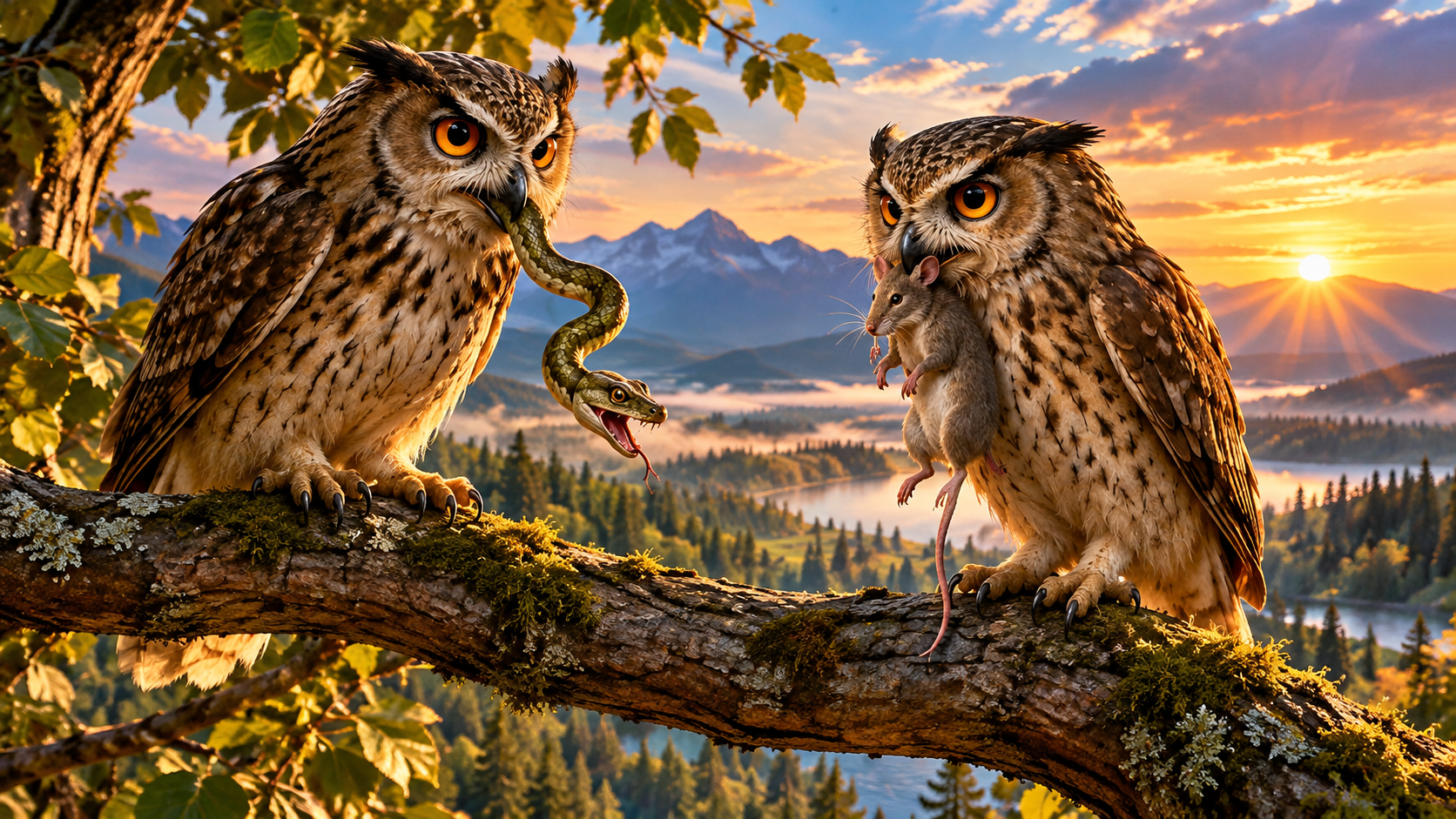
An original moral story inspired by an ancient-style wisdom tale about two owls, a snake, and a mouse—and the powerful lessons hidden within our deepest fears.
Introduction: The Wisdom Hidden in Nature
Sometimes, the greatest lessons in life come from the smallest moments in nature.
A bird sitting quietly on a branch, a frightened animal searching for safety, or a predator pursuing its next meal can reveal surprising truths about human emotions.
Deep in a peaceful mountain forest, two wise owls once witnessed an extraordinary encounter that changed the way they understood fear, desire, and the instinct to survive.
What began as an ordinary morning became a lesson neither owl would ever forget.
This is the story of two owls, a hungry snake, and a terrified mouse—and the wisdom they discovered when fear and desire collided.
1. Two Owls Meet Beneath the Morning Sky
High in the mountains, where ancient trees stretched toward the clouds and cold streams flowed through quiet valleys, stood a magnificent cedar tree.
Its branches provided shelter for countless creatures.
One morning, two owls arrived at the tree from opposite directions.
The first owl, named Tashi, was older and known for his patience. His feathers were dark brown, and his golden eyes seemed to notice everything.
The second owl, named Dorje, was younger and curious about the world.
Both had been hunting before sunrise.
Tashi carried a small snake in his beak, while Dorje had caught a field mouse.
They settled on separate branches, close enough to see each other.
“Good morning, brother,” Dorje greeted him.
“A peaceful morning indeed,” Tashi replied.
Neither owl knew that their ordinary breakfast would soon reveal something extraordinary.
2. The Snake That Forgot Its Danger
As Tashi adjusted his position on the branch, the snake hanging from his beak noticed the mouse held by the other owl.
Immediately, its attention shifted.
Although the snake was trapped and unable to escape, its hunting instinct awakened.
The mouse was close.
So close that the snake could almost reach it.
Its body twisted.
Its eyes fixed upon the smaller creature.
Its tongue flickered rapidly.
For one brief moment, the snake seemed to forget that it was already in terrible danger.
Instead of concentrating on escaping, it became consumed by the possibility of another meal.
Dorje watched in astonishment.
“Look at that snake!” he exclaimed.
Tashi remained still.
“It sees only what it wants,” he said quietly.
The snake continued struggling toward the mouse, driven by an instinct stronger than its awareness of its surroundings.
3. The Mouse That Feared the Wrong Danger
Meanwhile, the mouse noticed the snake.
Its tiny body began trembling.
Its eyes widened.
Although it was already trapped in Dorje’s beak, its attention turned entirely toward the snake.
The mouse seemed terrified by the possibility of being attacked.
It struggled desperately, not because it understood its immediate situation, but because the snake represented a familiar danger.
Dorje gently tightened his grip to prevent the mouse from falling.
“How strange,” he whispered.
“What do you find strange?” Tashi asked.
“The mouse is frightened of the snake, even though it is already in my beak.”
Tashi studied the trembling creature.
“Fear does not always show us the whole truth,” he answered.
Dorje looked from the mouse to the snake.
One creature was consumed by hunger.
The other was overwhelmed by fear.
And neither seemed aware of its immediate circumstances.
4. The Question That Changed Everything
For a long moment, the two owls remained silent.
The morning breeze moved softly through the cedar branches.
Far below, sunlight began touching the mountain valley.
Finally, Dorje spoke.
“Brother, why does the snake continue seeking food when it is already in danger?”
Tashi considered the question.
“Because desire can narrow the mind,” he replied.
“And why does the mouse fear the snake more than the owl holding it?”
“Because fear can do the same.”
Dorje tilted his head.
“Then both creatures are trapped twice?”
Tashi nodded.
“Yes. Their bodies are trapped, but their attention is trapped as well.”
Dorje looked thoughtful.
“One is controlled by what it wants. The other is controlled by what it fears.”
“Exactly,” Tashi answered.
5. The Old Owl’s Lesson About Desire
Tashi looked toward the distant mountains.
“Long ago,” he began, “I knew a raven who collected shiny stones.”
Dorje listened.
“Every morning, the raven searched the valley for something more beautiful than what he already possessed. He gathered polished pebbles, broken glass, and tiny pieces of metal.”
“That sounds harmless,” Dorje said.
“At first, it was. But soon the raven spent so much time searching for treasures that he neglected his nest and barely rested.”
“What happened?”
“One day, a storm destroyed the nest he had forgotten to repair.”
Dorje lowered his head.
“Did he lose his collection?”
“Yes. But what saddened him most was realizing that he had spent his days collecting things he did not need while overlooking the shelter he already had.”
Tashi paused.
“Desire is not always wrong. Hunger encourages us to eat. Curiosity encourages us to learn. Ambition can help us grow.”
“Then when does desire become dangerous?” Dorje asked.
“When wanting something becomes more important than understanding what truly matters.”
6. The Younger Owl Learns About Fear
Dorje thought about the mouse.
“Then fear must also have a purpose,” he said.
“Of course,” Tashi replied. “Fear warns us about danger. Without it, many creatures would not survive.”
“But the mouse is afraid of something that is not its most immediate danger.”
“That is why fear must be accompanied by awareness.”
Dorje looked puzzled.
Tashi continued.
“Imagine a traveler walking along a mountain path. He hears a strange noise in the bushes and becomes frightened.”
“Perhaps a wolf is hiding there,” Dorje suggested.
“Perhaps. But perhaps the noise comes from the wind.”
“How can he know?”
“By observing carefully instead of allowing his imagination to decide everything for him.”
Dorje nodded slowly.
“Fear can warn us, but it cannot always tell us the truth.”
“Well said,” Tashi replied.
7. The Difference Between Fear and Awareness
The two owls continued their conversation as the forest awakened.
Birds began singing.
Leaves rustled in the morning breeze.
The distant sound of flowing water echoed through the valley.
Dorje asked another question.
“If fear and desire are natural, how can anyone avoid being controlled by them?”
Tashi answered gently.
“By learning to notice them.”
“Is that enough?”
“It is a beginning.”
The older owl explained that emotions often arrive before careful thought.
A frightening sound can make the heart race.
An attractive opportunity can awaken excitement.
A painful memory can create sadness or anger.
These reactions are part of being alive.
But awareness allows a creature to recognize what is happening before acting.
“The first feeling is not always the wisest guide,” Tashi said.
“Then what should guide us?”
“Patience, observation, and understanding.”
8. A Choice Beneath the Cedar Tree
Dorje looked again at the frightened mouse.
For the first time, he felt something beyond hunger.
He felt compassion.
“Brother,” he said, “we have learned something from these creatures. Perhaps we should give them a chance to live.”
Tashi looked at him with surprise.
“Why do you say that?”
“Because I want to remember this lesson through my actions, not only through words.”
Tashi considered his younger companion’s suggestion.
At last, he nodded.
The owls flew down to a sheltered clearing, where they released the two animals at a safe distance from each other.
The snake disappeared beneath a fallen log.
The mouse darted into thick grass.
Both vanished into the forest.
Dorje watched them go.
“Do you think they understood what happened?”
“Perhaps not,” Tashi replied. “But understanding is not always required for kindness to matter.”
Dorje smiled.
For once, he was not thinking about his next meal.
He was thinking about the meaning of the moment.
9. The Three Invisible Traps of Life
Later that afternoon, the owls rested beneath the shade of the cedar tree.
Dorje asked Tashi to explain the lesson one final time.
The older owl described three invisible traps that could cloud anyone’s judgment.
The Trap of Endless Desire
Wanting more is not necessarily wrong.
But when we become obsessed with obtaining something, we may overlook the good things already present in our lives.
A person might spend years chasing wealth while neglecting friendships, health, or peace of mind.
Ambition becomes harmful when it prevents us from recognizing what is truly valuable.
The Trap of Imagined Fear
Fear can protect us from real danger.
However, our minds can also become overwhelmed by possibilities that have not happened.
We may fear rejection before speaking.
We may fear failure before trying.
We may worry so much about tomorrow that we forget to appreciate today.
Learning to distinguish actual danger from imagined outcomes helps us make calmer decisions.
The Trap of Living Without Awareness
Both the snake and the mouse reacted to what captured their attention.
Neither paused to understand its situation.
Human beings can experience something similar.
We may become so focused on our desires, worries, or frustrations that we overlook the reality in front of us.
Awareness helps us recognize our emotions without becoming completely controlled by them.
10. The Wisdom That Traveled Beyond the Forest
As the years passed, Dorje became an older and wiser owl.
He traveled across valleys, mountains, and forests.
Whenever younger birds asked him about the greatest lesson he had learned, he told them about the morning beneath the cedar tree.
He described the snake that forgot its danger because it wanted another meal.
He described the mouse that became overwhelmed by fear.
And he remembered the patient owl who had helped him understand what he was witnessing.
One evening, a young owl asked him:
“What is the secret to living wisely?”
Dorje looked toward the stars.
“Do not believe that every desire must be followed,” he answered.
“And do not believe that every fear must be obeyed.”
The young owl remained silent.
Dorje continued.
“Learn to observe what is happening around you. Learn to understand what is happening within you. Then choose your actions with care.”
The young owl smiled.
“That sounds difficult.”
Dorje laughed softly.
“It is. That is why wisdom takes a lifetime to practice.”
The Moral of the Story: Don’t Let Fear and Desire Blind You
The story of the two owls reminds us that our strongest emotions can sometimes prevent us from seeing situations clearly.
The snake represents uncontrolled desire.
The mouse represents overwhelming fear.
The owls represent awareness and the ability to learn from what we observe.
The lesson is not that desire and fear are bad.
Both serve important purposes.
Desire can inspire progress, while fear can protect us from danger.
But when either emotion becomes too powerful, it may narrow our attention and lead us toward unwise decisions.
True wisdom begins when we learn to pause, observe, and understand before acting.
How to Apply This Story to Everyday Life
1. Recognize What You Truly Need
Before pursuing something, ask yourself whether it will genuinely improve your life or simply satisfy a temporary craving.
2. Question Your Fears
When you feel afraid, consider whether the danger is immediate and real or whether your mind is imagining a possible outcome.
3. Practice Being Present
Pay attention to what is happening now instead of becoming completely absorbed in future worries or endless ambitions.
4. Make Decisions With Patience
Strong emotions can make immediate action feel necessary. Taking a moment to reflect may reveal better choices.
5. Remember What Matters Most
Success, possessions, and achievements can be meaningful, but they should not come at the expense of compassion, relationships, and inner peace.
Final Thoughts: The Greatest Freedom Is a Clear Mind
The forest did not change after the two owls witnessed the strange encounter.
The mountains remained silent.
The river continued flowing.
The cedar tree continued reaching toward the sky.
But something had changed inside Dorje.
He had discovered that the greatest traps are not always the ones we can see.
Sometimes, they are created by our own fears and desires.
And sometimes, freedom begins not by changing the world around us, but by changing the way we understand it.
The story leaves us with one powerful reminder:
Do not become so consumed by what you want that you forget what you have, or so frightened by what might happen that you forget to live today.
Wisdom is not the absence of fear or desire. It is the ability to see clearly even when both are present.