Some childhood memories are connected to big adventures, favorite cartoons, and afternoons spent playing with friends. Others are much simpler: the sound of tiny buttons clicking, a few falling blocks on a monochrome screen, and the excitement of beating your own high score.
For many people who grew up in the 1990s and early 2000s, the little Brick Game handheld console was a familiar companion. It did not need a television, an internet connection, or expensive game cartridges. It was small enough to carry in a pocket or schoolbag, yet entertaining enough to keep us busy during long journeys, quiet afternoons, and family trips.
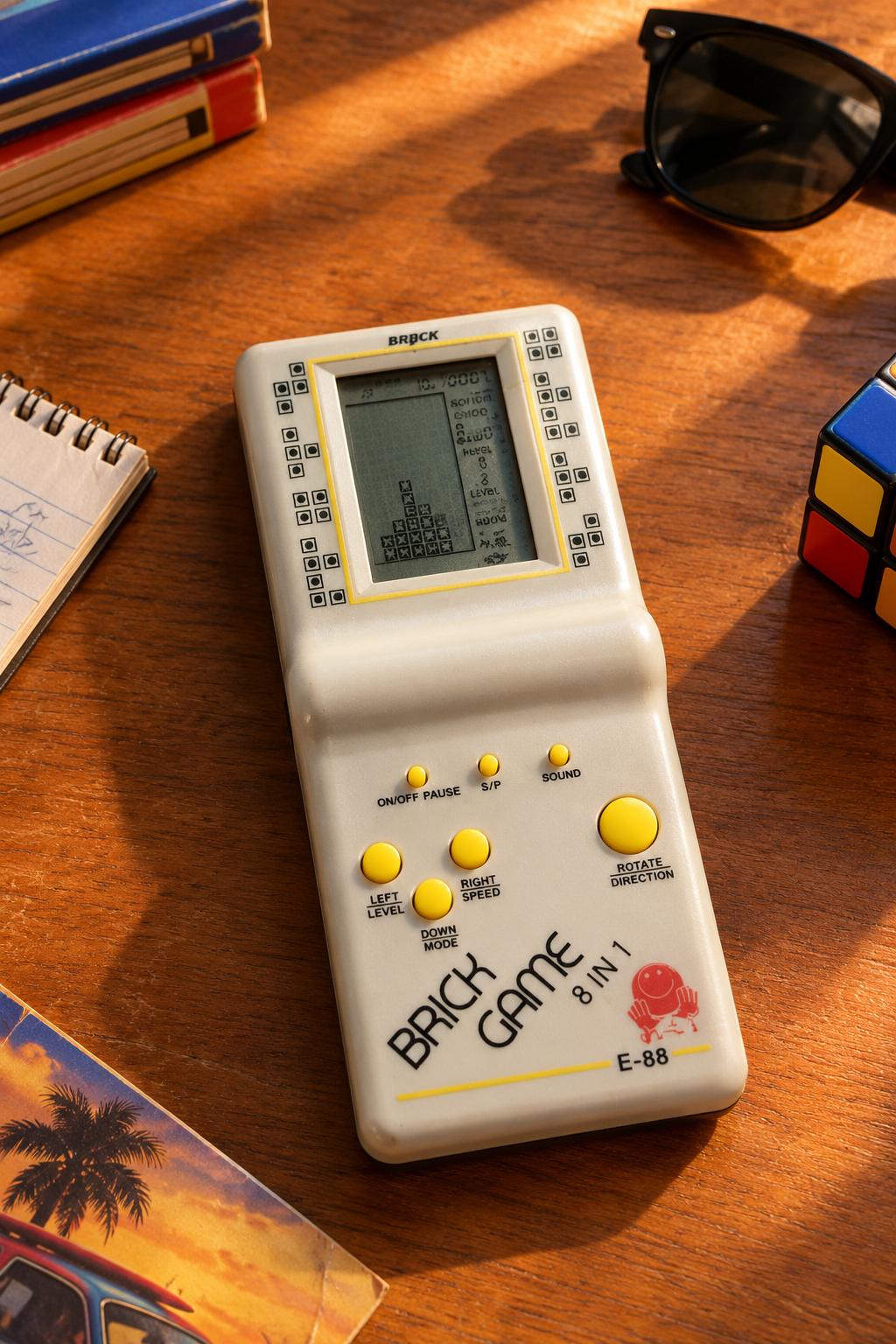
The device in our photograph is marked “Brick Game 8 in 1” and “E-88.” Its simple LCD screen, cream-colored body, and bright yellow buttons capture the charm of an era when portable gaming was all about simple challenges and one more attempt at a new record.

1. Meet the Little Console That Created Big Memories

The Brick Game was a dedicated electronic gaming device built around simple, built-in games. Unlike modern handheld consoles, it did not offer a colorful display or a library of downloadable titles. Instead, it relied on a basic liquid-crystal display (LCD), physical buttons, and straightforward gameplay.
The E-88 model shown here has a distinctive shape, a small screen surrounded by decorative markings, and several yellow controls. Its “8 in 1” label suggests a collection of game modes or variations in one device. On consoles like this, the number of advertised games could include changes in speed, difficulty, or play style rather than eight completely different gaming experiences.
Fandom
+1
That simplicity was part of the appeal. You could switch it on and begin playing almost immediately.
2. The Game We Could Play Almost Anywhere

One of the biggest attractions of these consoles was their portability. There was no need to find a television, set up a console, or wait for a game to load. The controls were right in front of you, and the game was ready whenever you were.
A Brick Game could become entertainment during:
- Long car rides and family journeys.
- Waiting rooms and quiet afternoons.
- School breaks, where permitted.
- Rainy days at home.
- Moments when there was nothing else to do.
The small screen might seem limited today, but it gave players a clear goal: make the right move, keep the game going, and try to beat the previous score.
3. Why the Falling-Block Puzzle Was So Addictive

The familiar falling-block puzzle was a major part of the Brick Game experience. Shapes dropped into a narrow playing area, and players had to move and rotate them to create complete rows.
It was easy to understand, but getting better took practice. A small mistake could leave an awkward gap. A well-timed rotation could save a round. And as the pace increased, there was less time to think.
That combination made the game rewarding. You did not need a long tutorial or complicated controls. You simply learned by playing.
For many players, the real challenge was not just completing rows. It was staying focused long enough to beat a personal best.
4. Getting Started: A Step-by-Step Trip Back to Childhood
If you have found an old Brick Game in a drawer or bought one from a retro toy collector, here is how to enjoy the experience again.
Step 1: Take a closer look at the console

Check the body, screen, and buttons. Look for cracks, loose parts, or signs of battery leakage. Older electronics deserve a little care before you switch them on.
Step 2: Check the batteries

Check the battery compartment for corrosion or residue. Use only the battery type and arrangement specified for your particular unit. If you see leakage or significant corrosion, avoid touching the residue directly and have the device assessed before using it.
Step 3: Turn it on and choose a game

Press the power button and follow the labels on the console. Depending on the version, the controls may let you start or pause a game, change speed or level, and rotate a falling shape.
Because button layouts can vary between models, try one control at a time rather than assuming every Brick Game works exactly the same way.
Step 4: Learn the controls through practice

Begin at a slower speed if your console offers that option. Learn how the left and right controls move the pieces and how the rotation button changes their position. Give yourself time to get comfortable with the small display.
Step 5: Challenge yourself to beat your high score

Once you understand the controls, try to clear rows efficiently and avoid leaving isolated gaps. When the game ends, start again and see if you can improve your score. That simple loop is part of what made these devices so memorable.
5. The Buttons, Screen, and Design That Made It Special

The E-88’s design is a reminder that good entertainment does not always need advanced technology.
- The LCD screen: Its limited display kept the graphics simple and easy to recognize.
- The physical buttons: Each press gave players direct control over the action.
- The compact body: It was easy to hold and carry.
- The built-in games: There were no cartridges to lose or separate games to purchase.
- The speed and level controls: Where available, these settings added challenge without making the device complicated.
The screen may look basic beside today’s high-resolution displays, but that was never the point. The game depended on timing, planning, and repetition—not realistic graphics.
6. Why This Little Game Still Makes Us Feel Nostalgic

Nostalgia is often tied to the moments surrounding an object, not only to the object itself.
A Brick Game might remind someone of sitting in the back seat of a car, borrowing a friend’s toy, playing after homework, or trying to stay awake during a long journey. The device becomes a small reminder of a time when entertainment could be uncomplicated.
It also reflects how gaming changed. Early handheld electronic games made portable play possible long before modern mobile phones and advanced gaming systems became everyday objects. Simple LCD games formed part of that broader history of handheld entertainment.
Wikipedia
+1
For many owners, the value of an old console is therefore not measured by its graphics or processing power. It is measured by the memories attached to it.
7. The Brick Game Compared With Modern Gaming
| Feature | Classic Brick Game | Modern handheld gaming |
|---|---|---|
| Display | Small monochrome LCD | Usually high-resolution color |
| Games | Built-in game modes | Large game libraries |
| Controls | Physical buttons | Buttons, sticks, touch, or motion controls |
| Connectivity | Usually none | Often online and wireless |
| Main appeal | Simple, quick challenges | Wide range of experiences |
| Nostalgic value | Strong for many former players | Still developing for today’s players |
Modern gaming offers more choice, but the Brick Game had a different kind of charm. It was straightforward, portable, and focused on one immediate goal. There were fewer distractions between you and the game.
That is why revisiting one today can feel refreshing: you can play for a few minutes without needing to connect to anything or learn a complicated system.
8. Is the E-88 Brick Game Worth Keeping Today?

If you still own one, it may be worth keeping—not necessarily because it is a powerful gaming device, but because it represents a memorable chapter in portable gaming.
Collectors and nostalgic gamers may appreciate:
- Original markings and buttons that remain intact.
- A working LCD screen and responsive controls.
- The original packaging or instruction leaflet, if available.
- A clean battery compartment without corrosion.
- The personal story of where and when the console was used.
Before buying a used model, ask for clear photographs and confirmation that the screen, buttons, and battery compartment have been checked. Prices can vary considerably with condition, completeness, and seller demand, so compare several listings rather than assuming every old unit is rare or valuable.
9. A Small Console With a Lasting Place in Our Memories
The Brick Game E-88 may not compete with modern consoles on graphics, sound, or features. It does not need to. Its charm comes from its simplicity: a small screen, a handful of buttons, and a game that could keep us trying again and again.
Looking at this little handheld brings back the feeling of discovering entertainment without endless options. There was only the next move, the next row, and the hope of a better score.
Technology keeps moving forward, but childhood memories have their own way of staying with us. Sometimes, all it takes is an old plastic game console to bring those moments back.