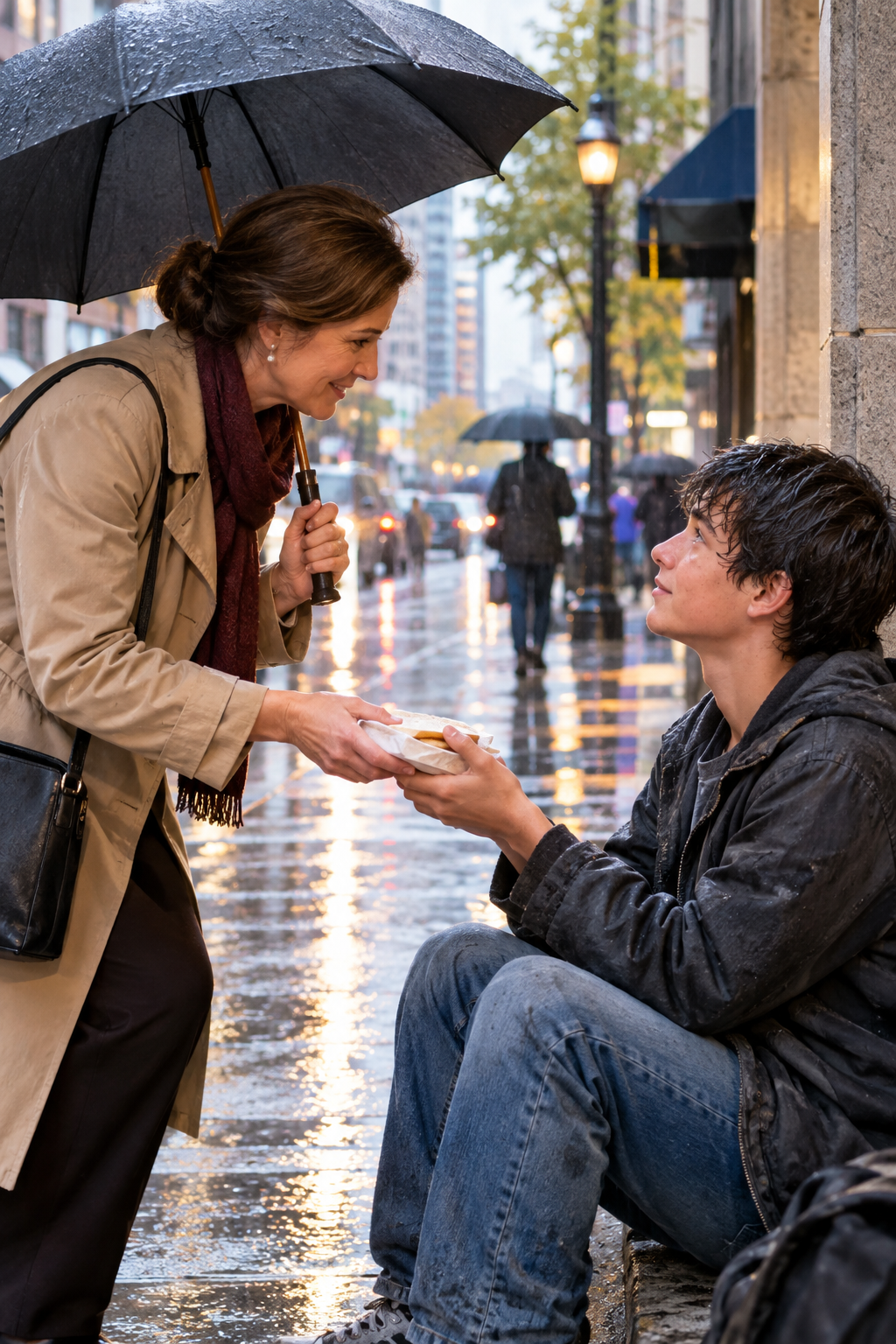
A Mistake on a Rainy Street
Rain had turned the city sidewalks into shining ribbons of gray. Cars crawled through the evening traffic, their headlights trembling in puddles, while people hurried beneath umbrellas, eager to reach warm homes.
Seventeen-year-old Marcus walked alone near the corner of Pine and Seventh Street.
His jacket was thin. His stomach was empty. In his pocket were three coins, barely enough for a bottle of water. He had spent the afternoon looking for small jobs, but nobody had hired him.
As he passed a bakery, the smell of fresh bread made his stomach tighten.
He stopped and stared through the window.
For a moment, he imagined himself sitting inside with a hot meal.
Then he noticed the woman walking ahead of him.
She carried a large brown handbag over one shoulder.
Marcus looked at the purse.
Then he looked around.
Nobody seemed to be watching.
A terrible idea entered his mind.
He followed her.
The Moment Everything Changed
The woman was in her fifties and walked slowly, carefully avoiding the deepest puddles. She wore a simple coat and carried a paper bag in one hand.
Marcus moved closer.
His heart began beating faster.
He told himself he would only take the purse and run. He wouldn’t hurt her. He needed money, and he needed it now.
But when he reached for the strap, the woman suddenly turned.
Marcus grabbed the purse.
The woman held on.
For several seconds, neither of them moved.
Then the strap slipped from her shoulder, and Marcus stumbled backward.
He expected screaming.
He expected anger.
Instead, the woman looked directly into his frightened eyes.
“Are you all right?” she asked.
Marcus froze.
The question made no sense.
He had just tried to steal from her, yet she was asking if he was okay.
“I’m sorry,” he muttered.
The woman picked up her paper bag from the wet sidewalk.
“You’re hungry, aren’t you?”
Marcus looked away.
“No.”
His stomach answered for him with a loud growl.
The woman raised an eyebrow.
Marcus felt his face burn.
A Door He Did Not Expect
“My name is Mrs. Elena Carter,” she said. “And you look like someone who hasn’t had a decent meal today.”
Marcus didn’t know what to say.
She pointed toward a small diner across the street.
“Come with me.”
Marcus stepped back.
“Why?”
“Because I’m not giving you money.”
He looked confused.
“But I will buy you dinner.”
Marcus stared at her as if she had spoken another language.
“You don’t know me.”
“That’s true.”
“I tried to steal your purse.”
“I noticed.”
“And you’re still inviting me to eat?”
Mrs. Carter smiled slightly.
“Making one terrible decision doesn’t mean you have to make another.”
Marcus followed her across the street.
The Secret in the Brown Bag
Inside the diner, warmth surrounded them. The windows were fogged from the rain, and the smell of coffee, soup, and fried potatoes filled the room.
Mrs. Carter ordered Marcus a meal.
He ate quickly at first, almost afraid someone might take the plate away.
Then he slowed down.
Mrs. Carter quietly drank her tea.
After several minutes, she asked, “What’s your name?”
“Marcus.”
“Marcus what?”
“Marcus Hill.”
She nodded.
“How old?”
“Seventeen.”
“School?”
Marcus lowered his eyes.
“I quit.”
“Why?”
“My mother died two years ago. My father left before that. I was staying with my aunt, but she couldn’t keep me anymore.”
Mrs. Carter listened without interrupting.
Marcus rubbed his hands together.
“I’ve been sleeping wherever I can. Sometimes at a friend’s place. Sometimes at the bus station.”
Mrs. Carter looked at him carefully.
“Is that why you tried to steal my purse?”
Marcus nodded.
“I thought I could get enough money for food.”
She looked down at the brown paper bag beside her chair.
Marcus noticed it.
“What’s in there?” he asked.
“Something I bought for my grandson.”
She paused.
“He is about your age.”
Marcus looked at the bag again.
“Does he live with you?”
“No. He lives across town.”
“Does he know you’re here?”
Mrs. Carter smiled.
“He knows I worry about him.”
Marcus didn’t understand why she suddenly looked sad.
Shoes That Were Too Small
After dinner, Mrs. Carter reached into her purse.
Marcus immediately stiffened.
She pulled out her wallet.
He looked away.
“I don’t want money,” he said.
“I wasn’t going to give you money.”
She removed a small card from the wallet and placed it on the table.
It had an address written on it.
“A community center,” she explained. “They help teenagers find temporary housing, finish school, and learn job skills.”
Marcus stared at the card.
“You think they’ll help me?”
“I know they help people who are willing to help themselves.”
Marcus picked it up.
Then he noticed something else.
Mrs. Carter looked down at his shoes.
The soles were almost completely worn through.
“Those shoes won’t last another week,” she said.
Marcus shrugged.
“They still work.”
“That’s not the same thing.”
She stood.
“Come on.”
“Where?”
“There’s a store next door.”
Marcus shook his head.
“I can’t let you buy me shoes.”
“You tried to steal my purse ten minutes ago. I think we’re past worrying about whether you deserve a pair of shoes.”
For the first time that evening, Marcus laughed.
The Warning He Never Forgot
At the small shoe store, Mrs. Carter helped him choose a pair that fit properly.
Marcus stared at his reflection in the mirror.
The new shoes looked strange on his feet.
Almost too clean.
Almost too good.
He whispered, “I can’t believe this.”
Mrs. Carter stood beside him.
“Remember something, Marcus.”
He looked at her.
“Things you get the wrong way can become a burden. A pair of shoes bought with stolen money might look wonderful, but guilt can make every step painful.”
She touched the box lightly.
“Good things should never have to begin with someone else’s loss.”
Marcus nodded.
Mrs. Carter smiled.
“Walk carefully in those shoes.”
“I will.”
“And don’t let anybody convince you that being poor means you have to become dishonest.”
Marcus swallowed hard.
“I won’t.”
The Choice
The next morning, Marcus stood outside the community center.
He almost turned around.
He was afraid they would reject him.
Afraid they would ask too many questions.
Afraid his past would follow him through the door.
Then he looked down at his new shoes.
He remembered Mrs. Carter’s words.
He walked inside.
Over the next several months, Marcus worked harder than he ever had before.
He enrolled in evening classes. He found part-time work at a grocery store. He learned basic computer skills and began repairing old bicycles for extra money.
Life did not suddenly become easy.
There were still nights when he was tired.
There were still bills he couldn’t pay.
There were still moments when he wondered whether anyone truly believed in him.
But now he had something he had never had before.
A reason to believe in himself.
The Woman at the Bus Stop
A year later, Marcus was walking home from work when he saw a familiar figure waiting at a bus stop.
Mrs. Carter.
He stopped.
She looked at him for several seconds before recognizing him.
“Marcus?”
He smiled.
“Hello, Mrs. Carter.”
She looked him up and down.
“You kept the shoes?”
Marcus laughed.
“Not those exact ones. I’ve worn them out.”
“Good.”
She smiled.
“I was hoping you would.”
Marcus reached into his backpack and pulled out a small envelope.
“What’s that?” she asked.
He handed it to her.
Inside was a photograph of Marcus standing outside a technical college. Beneath the photograph was a short note.
“I got accepted.”
Mrs. Carter read the note twice.
Then she looked at him.
“I’m proud of you.”
Marcus nodded.
“I almost didn’t come into that community center.”
“But you did.”
“Because of you.”
Mrs. Carter shook her head.
“No. Because you decided to.”
Marcus smiled.
For a moment, the noise of the city seemed to disappear.
He remembered the rainy street, the brown purse, the fear in his chest, and the kindness he had never expected.
He had thought that night was about stealing a purse.
He later understood that it had really been about something else.
Someone had stopped him from stealing his own future.
A Lesson Worth Carrying
Marcus never forgot Mrs. Carter’s kindness, but he also never forgot that she had not simply rescued him.
She had trusted him with a choice.
She had shown him that dignity could survive a terrible mistake, and that a person could change direction even after taking a wrong turn.
Years later, when Marcus had a steady job and a home of his own, he kept one old photograph in a drawer.
It showed a seventeen-year-old boy wearing a pair of new shoes.
The shoes were gone.
The boy had grown up.
But the lesson remained.
Sometimes the smallest act of kindness can become the first step toward an entirely different life.