
Imagine a world without cars, airplanes, or high-speed trains. Moving heavy goods across long distances was slow and expensive. Most people traveled by horse, carriage, or boat, and industries struggled to transport coal and raw materials efficiently.
Then came a man who believed that steam could change everything.
He wasn’t born into a wealthy family. He had little formal education, worked in coal mines, and spent years learning how machines operated. Yet his determination helped transform an experimental technology into a practical transportation system that would reshape the modern world.
His name was George Stephenson, the English engineer widely known as the Father of Railways.
Stephenson did not create the first steam locomotive in history. Instead, he improved existing ideas, developed effective locomotives, and helped prove that steam-powered railways could carry people and goods on a large scale. His journey was filled with technical problems, financial uncertainty, and resistance from people who doubted his vision.
This is the story of how a hardworking man from a humble background helped change the way the world moved.
1. A Humble Beginning: The Boy Who Dreamed of Machines

George Stephenson was born on June 9, 1781, in Wylam, Northumberland, England. His father, Robert Stephenson, worked as an engine operator at a local colliery, where steam-powered machinery helped pump water from mines.
The family had limited financial resources, and George did not receive the kind of formal education available to wealthier children.
Instead, he grew up surrounded by the sights and sounds of industrial life. He saw enormous machines working in difficult conditions and watched workers struggle to keep them running.
For many children, a coal mine represented a place of exhausting labor. For George, it also became an informal classroom.
He developed a fascination with engines and mechanical equipment. He wanted to understand how machines worked, why they broke down, and how they could be improved.
However, his family could not afford to send him to a prestigious engineering school. If he wanted to learn, he would have to find another way.
Learning while working
As a young teenager, Stephenson began earning money through agricultural and mining work. Eventually, he found employment connected with the machinery used in coal mines.
He learned by observing experienced workers, asking questions, and practicing practical skills. Later, he studied reading and mathematics to improve his knowledge.
His progress was gradual, but each new skill helped him move closer to his ambition.
Lesson: You do not always need a perfect beginning to build an extraordinary future. Curiosity and consistent learning can open doors that once seemed impossible to reach.
2. From Coal Miner to Skilled Engine Mechanic

Stephenson’s early working life was physically demanding. Coal mines were dangerous places, and the machinery operating inside them required constant attention.
Yet these challenges helped him develop practical engineering knowledge.
He became increasingly skilled at operating, maintaining, and repairing steam engines. His reputation grew because he understood machinery through direct experience rather than theory alone.
He also continued educating himself outside working hours. He learned to read, studied arithmetic, and improved his ability to calculate measurements and understand mechanical problems.
By the time he gained greater responsibility at Killingworth Colliery, he had developed an unusually strong combination of practical experience and self-taught knowledge.
He understood that machinery could save labor and improve productivity—but only if it worked reliably.
This insight would become crucial when he turned his attention to steam locomotives.
3. The Big Idea: Could Steam Pull Coal Wagons?

During the early Industrial Revolution, coal was essential. It powered factories, heated buildings, and supported the growing iron industry.
But transporting coal from mines to factories, canals, and ports was difficult. Horses pulled heavy wagons along wagonways, while stationary steam engines were used for certain hauling operations.
Engineers had already begun experimenting with locomotives that could move along rails under their own power.
Richard Trevithick had demonstrated an early steam locomotive in 1804, while other inventors, including William Hedley and his collaborators, were developing machines for industrial wagonways.
Stephenson recognized that the technology had potential, but important problems remained.
- Early locomotives could be heavy and unreliable.
- Rails could break under excessive loads.
- Wheels sometimes slipped, limiting traction.
- Steam engines needed improvements in power and efficiency.
- Mine owners needed convincing evidence that the technology was worth the investment.
Stephenson believed these problems could be overcome.
He wanted to build a locomotive that could pull heavy coal wagons more effectively and reduce the cost of transporting materials.
It was an ambitious idea, especially for a man who had not followed a conventional engineering education.
4. The First Major Risk: Building Blücher in 1814

In 1814, Stephenson built an early locomotive called Blücher for the Killingworth Colliery.
This was a major step in his career. Rather than merely maintaining existing engines, he was now developing a machine intended to solve a practical industrial problem.
Building the locomotive required careful work on its boiler, cylinders, wheels, and driving mechanism. Every component had to function together under demanding conditions.
The project also involved financial risk. The colliery owners needed to believe that investing in the machine would provide worthwhile results.
If the locomotive failed, the experiment could damage Stephenson’s reputation and discourage further investment.
The first successful test
On July 25, 1814, Blücher underwent a successful trial. It demonstrated that a steam locomotive could haul a substantial load of coal wagons along the railway.
Historical accounts report that it pulled around 30 tons up a slight gradient at approximately four miles per hour. Although the machine had limitations, it proved that Stephenson’s approach had real potential.
This achievement did not mean that the problems were solved. The locomotive was cumbersome, and early designs required continuing improvements.
But the test gave Stephenson something invaluable: evidence that his ideas could work.
He continued refining his designs, building further locomotives, and learning from their performance.
5. Improving the Technology One Problem at a Time

Stephenson’s progress did not come from a single brilliant invention. It came from a process of testing, observation, and improvement.
He recognized that locomotives needed more than powerful boilers. Their wheels had to grip the rails, their moving parts had to withstand repeated use, and their designs had to be compatible with the tracks beneath them.
He worked on improvements to locomotive construction and the relationship between the engine and the railway.
Stephenson also understood that the track itself mattered. A locomotive could not perform well if the rails were unsuitable for its weight or the route contained poorly designed gradients.
This practical approach helped him develop a deeper understanding of railway engineering.
His experience with mine machinery also led him to work on a safety lamp for miners in 1815, during the same period that Humphry Davy was developing his own design. The competing claims surrounding the invention became controversial, but both efforts addressed the serious danger of explosions caused by flammable mine gases.
By continually learning and experimenting, Stephenson expanded his reputation beyond the coal mines.
6. The Meeting That Changed Everything

In the early 1820s, an important opportunity appeared.
Edward Pease, a businessman from Darlington, supported a proposal for a railway connecting coal-producing areas with Stockton, where coal could be transported onward by water.
The project initially contemplated using horses to pull railway wagons. Stephenson believed steam locomotives would be a better option for important sections of the route.
He presented his ideas and engineering plans to the people responsible for the proposed railway.
Stephenson had considerable practical experience, but he did not possess the prestigious educational credentials associated with many professional engineers of his era. Some people questioned whether he could manage such a large undertaking.
Pease, however, recognized his enthusiasm and practical knowledge.
In 1821, Stephenson became involved in the Stockton and Darlington Railway project, helping to advance the use of steam locomotives.
This was the turning point he needed.
For years, Stephenson had worked to demonstrate that steam locomotives could be useful. Now he had an opportunity to help build a railway where the technology could prove itself on a much larger scale.
7. Building a Locomotive for a Public Railway

Image alt text: A reconstruction of Locomotion No. 1, the steam locomotive built for the Stockton and Darlington Railway.
The Stockton and Darlington Railway required more than a promising experiment. It needed a working transportation system capable of carrying coal and other goods along a planned route.
Stephenson’s locomotive designs had to meet the demands of real operations.
In 1823, George Stephenson and his son Robert helped establish Robert Stephenson & Company in Newcastle with financial support from partners including Edward Pease and Thomas Richardson. The company became an important early locomotive manufacturer.
The locomotive constructed for the new railway was originally named Active and later became known as Locomotion No. 1.
Its design reflected years of practical experimentation. It used steam power to drive its wheels and pull wagons along iron rails.
But building the machine was only one part of the challenge. The railway also needed suitable tracks, organized operations, and a plan for moving people and goods safely.
The stakes were significant. A successful public railway could encourage investment in similar projects. A failure might convince potential investors that locomotive technology was too risky.
Stephenson was no longer proving his idea to a small group of mine owners. He was helping demonstrate its value to a much wider audience.
8. September 27, 1825: The Journey That Made History

The day finally arrived.
On September 27, 1825, the Stockton and Darlington Railway officially opened. Locomotion No. 1, driven by George Stephenson, hauled a train carrying coal, goods, and passengers.
The event marked a major milestone: the railway became the world’s first public railway to use a steam locomotive to haul a passenger train. Horses were also used on parts of the wider railway system, so this was not yet a railway operated exclusively by steam locomotives.
People gathered to watch a machine that produced clouds of steam, released smoke into the air, and pulled a line of vehicles along iron rails. For those accustomed to horse-drawn transportation, the sight offered a glimpse of an entirely different future.
The locomotive moved forward, carrying its load along the track.
What had once seemed experimental was now operating in a public transportation setting.
The railway demonstrated that steam-powered locomotives could contribute to the movement of heavy goods and passengers over a planned route.
For Stephenson, it was a defining professional achievement.
His years of work had helped turn an ambitious engineering concept into a practical railway system.
9. Another Challenge: Convincing the World That Railways Could Work

Even after the success of the Stockton and Darlington Railway, the future of steam transportation was not guaranteed.
Some investors and observers questioned whether locomotives could operate reliably over longer distances. Others worried about cost, noise, smoke, safety, and the engineering challenges of building railway lines.
Stephenson needed to demonstrate that railways could do more than transport coal over a limited route.
He believed that a railway connecting major industrial cities could change commerce and passenger travel.
One of his most important subsequent projects was the Liverpool and Manchester Railway.
The route presented difficult engineering problems, including the challenge of crossing Chat Moss, a large area of peat bog. The railway also required careful planning, substantial investment, and public confidence.
Stephenson’s work on the project helped establish his reputation as a leading railway engineer.
The railway opened in 1830, becoming a landmark in the development of intercity transportation powered by steam locomotives.
This achievement helped show that railways could become an important part of a country’s transportation infrastructure.
10. The Rocket and a New Era of Steam Travel

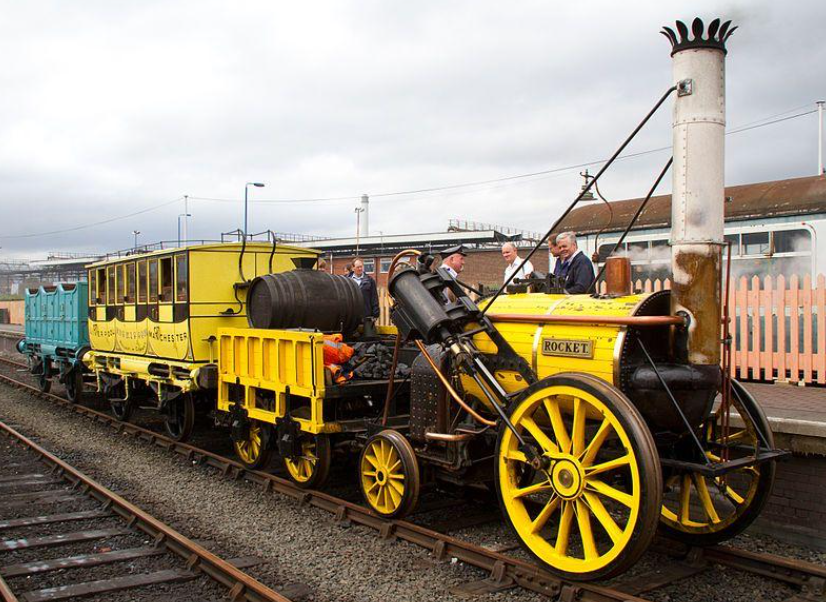
One of the most famous locomotives associated with the Stephenson family was Rocket.
In 1829, the Liverpool and Manchester Railway organized the Rainhill Trials to evaluate competing locomotive designs. The competition was intended to help determine the best way to power the new railway.
Rocket was developed under the direction of George Stephenson’s son, Robert Stephenson, working with the family’s locomotive-building business.
Its design included important features that improved steam production and overall performance.
Rocket won the trials, strengthening confidence in the locomotive technology developed by the Stephensons and their collaborators. Historical accounts report that it reached speeds of around 30 miles per hour during the competition.
The achievement helped establish the Stephenson name as a major force in railway engineering.
It also demonstrated an important distinction: railway progress depended on generations of work by inventors, engineers, manufacturers, investors, and railway builders—not a single inventor working alone.
George had helped build the foundations, while Robert and other skilled contributors advanced the technology further.
11. How Steam Railways Changed the World

The growth of railways changed much more than the way people traveled.
Steam-powered trains helped move coal, iron, manufactured products, agricultural goods, and passengers more efficiently along established routes.
Factories could connect with ports and markets over greater distances. Towns gained improved links to industrial centers. Railway construction created demand for iron, engineering expertise, bridges, stations, and new forms of infrastructure.
Railways also changed people’s experience of distance. Journeys that once took a long time by road could become faster and more predictable.
These changes helped support industrial and commercial growth, although railway expansion also brought challenges, including land disputes, dangerous working conditions, environmental effects, and the disruption of existing communities.
Stephenson lived long enough to see railway networks expand dramatically.
He died on August 12, 1848, but his engineering work and influence continued through the railways built in Britain and beyond.
His story remains a reminder that technological progress often emerges from many years of experimentation, collaboration, and determination.
12. What We Can Learn from George Stephenson’s Story

George Stephenson’s journey offers useful lessons for aspiring engineers, entrepreneurs, students, and anyone working toward a difficult goal.
Believe in the value of your idea
Stephenson saw potential in steam locomotives when the technology still had major limitations. He continued developing his ideas instead of assuming that early failures meant the concept was impossible.
Learn through practical experience
He developed much of his expertise by working with real machinery. His story shows how observation, practice, and curiosity can complement formal education.
Take calculated risks
Building locomotives and convincing investors to support railways required courage. But Stephenson’s work was grounded in testing, experience, and efforts to solve specific problems.
Improve your work continuously
His first locomotive was not the final answer. Each new design offered opportunities to learn more about power, traction, reliability, and railway operation.
Build relationships with other people
Railways were not created by one person alone. Investors such as Edward Pease, engineers such as Robert Stephenson, skilled workers, manufacturers, and railway companies all contributed to the development of the system.
Focus on long-term impact
Stephenson’s greatest contribution was not simply a machine. It was helping make railway transportation practical and encouraging a transformation that reached far beyond his own lifetime.
Conclusion: The Man Who Helped Put the World on Rails

George Stephenson’s story began in a working-class family in northern England. He did not have a privileged education or an easy path into engineering. Instead, he built his knowledge through hard work, observation, and a determination to understand how machines functioned.
His first locomotive, Blücher, was an important step in the development of practical steam-powered railway transportation. The Stockton and Darlington Railway later demonstrated the potential of steam locomotives in public service, and subsequent projects helped establish railways as a major force in modern industry.
Stephenson did not invent the first steam locomotive, and he was not the only person responsible for the railway revolution. But his engineering contributions, his commitment to improvement, and his role in building successful railway systems made him one of the most influential figures in railway history.
The world he helped shape is still visible today. Modern railways continue to connect communities, move goods, and carry millions of passengers.
His legacy teaches us that extraordinary achievements rarely happen overnight. They are built through curiosity, persistence, practical knowledge, collaboration, and the courage to keep working when success is uncertain.
Sometimes, one person’s determination can help move an entire world forward.