
Featured image alt text: Hans Wilsdorf and the early history of Rolex watches.
Imagine losing your parents as a child, watching your family’s business disappear, and then losing the money you inherited. For many people, such hardships would be enough to destroy their dreams. But one young man refused to give up.
His name was Hans Wilsdorf, and he dreamed of creating watches that were accurate, reliable, elegant, and useful in everyday life. He didn’t begin with a luxury empire or a famous brand name. Instead, he started with a passion for timekeeping and a determination to challenge the watchmaking industry.
That determination eventually helped create Rolex, one of the most recognizable luxury watch brands in the world.
This is the inspiring story of how a young orphan overcame setbacks, recognized opportunities others overlooked, and transformed a simple idea into a watchmaking legacy that continues to influence the world today.
1. A Difficult Childhood: The Beginning of a Remarkable Journey

Image alt text: A young boy in nineteenth-century Germany facing an uncertain future after losing his parents.
Hans Wilsdorf was born in 1881 in Bavaria, Germany. His childhood took a tragic turn when he lost both parents at around twelve years old.
Suddenly, the future that should have been filled with family support and childhood dreams became uncertain. His relatives took responsibility for him, and he was sent to boarding school. The family business was sold, and the financial security he might have expected was no longer part of his future.
Yet Hans had qualities that would later become essential to his success: curiosity, discipline, ambition, and an extraordinary interest in watches.
During his education, he learned about Switzerland’s growing reputation for precision watchmaking. The country was home to skilled craftsmen and businesses devoted to producing reliable timepieces.
For Hans, this discovery opened a door to a completely new future.
Rather than allowing his difficult childhood to define him, he began imagining a life in which he could build something of his own.
2. Discovering the World of Watchmaking

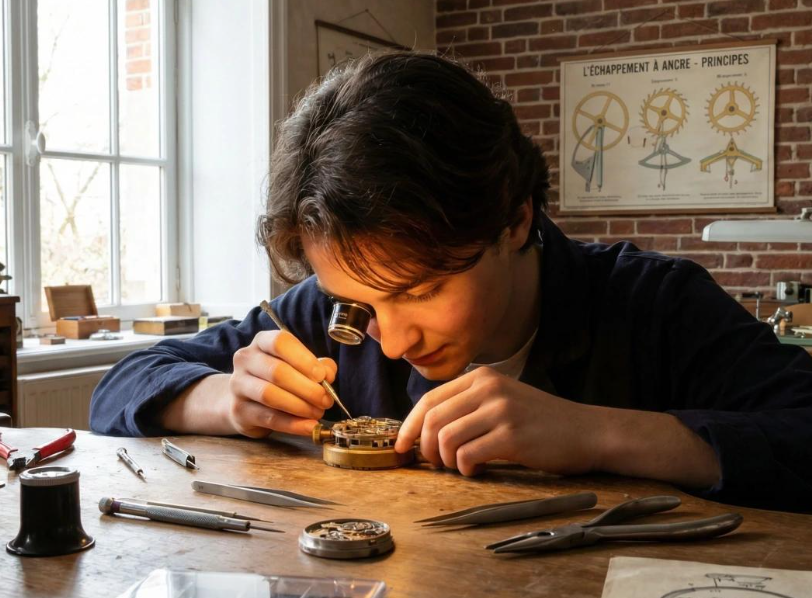
Image alt text: A young watchmaking apprentice studying a mechanical pocket watch in an early twentieth-century workshop.
In 1900, at the age of nineteen, Wilsdorf moved to Switzerland to pursue opportunities in the watch industry.
He found work with a watchmaking business in La Chaux-de-Fonds, a city known for its watchmaking tradition. His work involved handling watches and learning about their accuracy, construction, and performance.
This experience taught him something important: a beautiful watch was not necessarily a dependable one.
A timepiece could look impressive but still fail to keep accurate time. For customers who depended on trains, business appointments, and international travel, reliability mattered enormously.
Wilsdorf began to imagine a different kind of watch—one that combined precision with attractive design and practical everyday use.
He was not content simply to sell watches made by others. He wanted to help shape the future of the industry.
3. A Fresh Start in London—and Another Setback

Image alt text: An Edwardian London street representing the city where Hans Wilsdorf began building his watch business.
In 1903, Wilsdorf moved to London, hoping to expand his opportunities in the watch trade.
His journey was not without hardship. According to commonly repeated accounts of his life, he suffered the loss of the money he had inherited from his parents while traveling. The setback threatened the financial foundation on which he had hoped to build his future.
But Wilsdorf continued.
In London, he gained experience in watch sales and distribution. He learned how customers made purchasing decisions, what retailers wanted, and why certain products succeeded while others struggled.
He also recognized a market opportunity. Traditional pocket watches remained common, but they were not always convenient. Checking the time could require taking a watch out of a pocket, opening it, and putting it away again.
Wilsdorf believed there was a better solution.
He envisioned a small, accurate watch that people could wear on their wrists, making timekeeping more convenient and accessible.
At a time when wristwatches were not yet widely accepted by men, this was a bold prediction.
4. The Birth of Wilsdorf & Davis in 1905
Image alt text: Vintage pocket watches and watchmaking tools representing the early business of Wilsdorf and Davis.
In 1905, Wilsdorf partnered with his brother-in-law, Alfred Davis, to establish a watch business in London. The company became known as Wilsdorf & Davis.
Their business initially focused on importing Swiss watch movements and placing them into watch cases for sale.
This approach allowed Wilsdorf to combine Swiss watchmaking expertise with British commercial opportunities. Rather than building every component from scratch, the
would depend on more than technical quality. Customers needed to trust the product, recognize its name, and understand why it was worth buying.
The business began laying the groundwork for a brand that would eventually become famous around the world.
5. The Bold Decision to Make Wristwatches Popular

Image alt text: Early twentieth-century bracelet-style wristwatches that helped make wrist-worn timepieces fashionable.
At the beginning of the twentieth century, pocket watches were still widely used. Wristwatches were often regarded as delicate accessories rather than serious instruments for men.
Wilsdorf saw the situation differently.
He believed that people would eventually prefer watches they could wear on their wrists because they were easier to check throughout the day. However, he knew that simply producing wristwatches would not be enough. He needed to persuade customers that they were practical, fashionable, and reliable.
His solution was to combine precision timekeeping with attractive designs.
Early wristwatches could feature precious-metal cases and bracelet-like straps, helping them appeal to people who valued jewelry as well as functionality. By presenting wristwatches as elegant accessories with a practical purpose, Wilsdorf helped make them more appealing to a wider audience.
His strategy reflected a valuable business lesson: sometimes, creating a successful product means changing how people think about it.
6. Why Hans Wilsdorf Chose the Name Rolex

Image alt text: Antique watchmaking documents and a pocket watch representing the creation of the Rolex name.
A great product needs a memorable name. Wilsdorf understood this long before modern branding became a major part of business strategy.
He wanted a name that was short, distinctive, easy to pronounce in different languages, and small enough to fit neatly on a watch dial.
According to the traditional account, he experimented with numerous combinations of letters before settling on the name Rolex.
In 1908, he registered Rolex as a trademark.
The name offered several advantages. It was concise, visually balanced, and suitable for an international business. As the company expanded, it could serve as a consistent identity across different markets.
This decision helped establish the foundation of a brand that customers could recognize without needing to know the full name of its founder.
The lesson: A memorable brand name can become one of a company’s most valuable assets when it is supported by a dependable product and a clear vision.
7. The Pursuit of Perfect Accuracy

Image alt text: A precision mechanical watch movement with intricate gears and components.
Wilsdorf wanted Rolex watches to do more than look attractive. He wanted them to keep accurate time.
This was a significant challenge because early wristwatches were generally more exposed to movement, impacts, dust, and environmental conditions than watches carried inside pockets.
He invested considerable effort in sourcing reliable movements and improving their performance.
In 1910, a Rolex wristwatch movement received a Swiss certificate of chronometric precision. This achievement helped demonstrate that wristwatches could meet demanding standards of accuracy.
In 1914, a Rolex wristwatch received a Class A precision certificate from Britain’s Kew Observatory, a respected testing institution.
These milestones helped strengthen the credibility of wristwatches as serious timekeeping instruments.
Wilsdorf was building a reputation around a clear promise: a watch should be dependable, not merely decorative.
8. World War I Changes the Company’s Future

Image alt text: First World War soldiers using wristwatches to coordinate activities in the field.
Just as the business was growing, World War I created new obstacles.
International trade became more difficult, costs increased, and restrictions affected businesses operating across national borders. British import duties on watches also placed pressure on companies such as Wilsdorf & Davis.
Wilsdorf responded by moving important business operations to Switzerland, where Rolex could remain closely connected to the country’s watchmaking expertise.
The war also accelerated the practical adoption of wristwatches. Soldiers needed to check the time quickly without taking a pocket watch from their clothing. Coordinating movements and operations often depended on knowing the time.
Wristwatches offered a convenient solution.
Although military watches had existed before the war, the growing need for hands-free timekeeping helped change public attitudes toward wrist-worn watches.
The shift that Wilsdorf had anticipated was becoming increasingly visible.
9. The Rolex Oyster: A Watch Designed to Resist Water

Image alt text: A vintage-inspired Oyster wristwatch representing Rolex’s pioneering water-resistant case design.
By the 1920s, wristwatches were becoming more popular, but they still faced a serious technical problem: dust and moisture could damage their delicate internal mechanisms.
Wilsdorf wanted to solve this problem.
In 1926, Rolex introduced the Oyster, a watch designed with a specially sealed case. Its screw-down construction, including a protected winding crown, helped prevent water and dust from reaching the movement.
This was an important development in the evolution of water-resistant wristwatches.
The name Oyster was particularly appropriate because it suggested a protective shell around something valuable.
However, Wilsdorf knew that an innovation would have limited commercial value if customers did not understand its benefits. He needed to demonstrate that the watch could withstand conditions that might damage an ordinary timepiece.
That challenge led to one of Rolex’s most memorable marketing campaigns.
10. Mercedes Gleitze and the Famous English Channel Swim

Image alt text: A historical-style portrait representing endurance swimmer Mercedes Gleitze and her English Channel swimming achievements.
In 1927, British swimmer Mercedes Gleitze attempted to swim across the English Channel. Her endurance attracted public attention, and Wilsdorf recognized an opportunity to demonstrate the Oyster’s water-resistant design.
He arranged for her to wear a Rolex Oyster during a Channel swimming attempt.
Although Gleitze did not complete that particular crossing, the watch reportedly remained in working condition after spending hours exposed to cold water.
Wilsdorf used the event to promote the watch’s water resistance, including a prominent newspaper advertisement.
The campaign was powerful because it connected a technical claim with a real-world challenge. Rather than simply telling customers that the watch could resist water, Rolex presented a story that helped them understand why the feature mattered.
The company also used demonstrations in retail stores, displaying Oyster watches in water-filled aquariums.
This was an early example of experiential marketing: allowing potential customers to see a product feature demonstrated rather than relying entirely on advertising claims.
11. The Oyster Perpetual and the Automatic Watch Revolution

Even with improved water resistance, mechanical watches required regular winding. A wearer had to turn the crown to tighten the mainspring, which then gradually released energy to power the movement.
Wilsdorf wanted to make this process more convenient.
Rolex developed an automatic winding system using a freely moving rotor. As the wearer moved their wrist, the rotor turned and transferred energy to the mainspring.
This reduced the need for manual winding during normal wear.
Rolex introduced its Perpetual self-winding mechanism in 1931. Combined with the Oyster case, it helped establish the foundation of the Oyster Perpetual family.
The innovation represented an important step toward a more convenient everyday wristwatch.
It also illustrated Wilsdorf’s broader philosophy: successful watchmaking required continual improvements in accuracy, durability, and ease of use.
12. World War II and Another Test of Resilience

By the 1930s, Rolex had established itself as an important name in watchmaking. Yet the outbreak of World War II in 1939 brought another period of uncertainty.
The war disrupted international trade, transportation, and commercial activity. Many businesses faced shortages and difficulties reaching customers.
Wilsdorf also experienced a profound personal loss when his wife died in 1944.
Despite these challenges, he continued to guide the company and protect the business he had spent decades building.
His response reflected the same determination that had carried him through childhood hardship and the difficult early years of entrepreneurship.
He understood that a strong company needed more than a successful product. It also needed a long-term vision, consistent standards, and the ability to adapt when circumstances changed.
13. The Rolex Datejust: A New Milestone in 1945

In 1945, Rolex celebrated its fortieth anniversary by introducing the Datejust.
The watch combined automatic winding with an indication of the date in a window on the dial. It became an important model in the development of modern wristwatches.
The Datejust helped demonstrate how practical features could be incorporated into a refined design.
It was not simply about telling the time. The watch could also provide useful information at a glance while maintaining the elegance that customers expected from a luxury timepiece.
Over the following decades, Rolex continued developing watches for people with different needs, from everyday wear to professional activities.
14. Rolex Explores the World’s Most Extreme Environments

Rolex’s reputation grew as the company developed watches designed for demanding environments.
Several notable models helped establish this identity:
- Rolex Explorer (1953): Associated with mountaineering and exploration, the Explorer was designed for clear, dependable timekeeping in challenging conditions.
- Rolex GMT-Master (1955): Developed for international air travel, it featured an additional hour hand and a rotating 24-hour bezel to help track another time zone.
- Rolex Deep Sea Special: An experimental deep-diving watch that accompanied the 1960 Trieste expedition to the bottom of the Mariana Trench.
These developments demonstrated how watches could be adapted to the specific needs of explorers, pilots, and deep-sea researchers.
In 1960, the Trieste expedition reached the Challenger Deep, the deepest known part of the ocean. The Deep Sea Special attached to the outside of the bathyscaphe survived the extreme pressure during the descent.
Such achievements reinforced the connection between Rolex and engineering designed to withstand extraordinary conditions.
15. Hans Wilsdorf’s Final Years and Lasting Legacy

Hans Wilsdorf died in 1960 at the age of 79. By then, the business he had helped establish had developed into an internationally recognized watch brand.
His legacy extended beyond individual models or technical innovations. He helped change how people viewed wristwatches, demonstrating that they could be accurate instruments, durable companions, and symbols of refined design at the same time.
He also established the Hans Wilsdorf Foundation, which continues to play a central role in Rolex’s ownership structure.
Today, Rolex remains associated with precision, craftsmanship, exploration, and luxury. Its story began with one entrepreneur’s belief that a better watch was possible.
The young boy who faced uncertainty after losing his parents could never have known exactly how far his ambition would take him. But he continued learning, adapting, and working toward his vision.
That is what makes his story so enduring.
What We Can Learn from Hans Wilsdorf’s Success

The story of Rolex offers several lessons for anyone hoping to build a business or achieve an ambitious goal.
1. Difficult beginnings do not determine your future
Wilsdorf faced personal loss and financial setbacks, but he continued looking for opportunities. A difficult beginning can shape your experience without defining your destination.
2. Understand what customers actually need
He recognized that customers needed watches that were practical and dependable, not merely decorative. Successful businesses solve genuine problems.
3. Think ahead of the market
Wilsdorf believed wristwatches would become widely accepted before they were the obvious choice for everyone. His willingness to pursue that vision helped distinguish his company.
4. Make innovation part of your identity
From chronometric precision to water resistance and automatic winding, Rolex built its reputation through continuing technical development.
5. Tell people why your product matters
The Oyster’s marketing campaigns showed customers what water resistance meant in practice. Strong marketing communicates a product’s value in a memorable, credible way.
6. Keep going when circumstances change
Wars, financial pressures, and personal tragedy created serious challenges. Wilsdorf’s story demonstrates the importance of persistence, planning, and adapting to new realities.
Conclusion: From a Difficult Childhood to a Watchmaking Legend

Image alt text: A classic mechanical wristwatch overlooking a mountain landscape, symbolizing the enduring legacy of Rolex.
The story of Hans Wilsdorf is not simply the story of an expensive watch. It is the story of an entrepreneur who recognized an opportunity, pursued an ambitious vision, and kept improving his products even when success was far from certain.
From his early experiences in Switzerland and London to the creation of Rolex, Wilsdorf helped transform the wristwatch from a relatively uncommon accessory into a respected instrument of precision and style.
His achievements were not the result of one lucky decision. They came from years of learning, experimentation, marketing, and persistence.
Today, Rolex represents far more than the passage of time. Its history reflects the power of a clear vision supported by technical innovation and a lasting commitment to quality.
The most important lesson is simple: your starting point does not have to determine your destination. With curiosity, determination, and the courage to challenge conventional thinking, an idea that once seemed impossible can grow into something extraordinary.