Dead Ghosts Walking
There are ghost stories that make you nervous when you hear them at night.
Then there are stories that stay with you long after the lights come back on.
“Dead Ghosts Walking” belongs to the second kind.
Across different cultures and generations, people have described encounters with figures that appeared to be neither fully alive nor completely gone. A person walking alone along an empty road. A stranger standing beneath a streetlight who disappears when approached. Footsteps moving through an abandoned building despite there being nobody inside.
Some believe these are spirits trapped between worlds. Others argue that exhaustion, fear, darkness, and memory can create remarkably convincing experiences.
But what happens when several people claim to witness the same thing?
That is where the mystery becomes difficult to dismiss.
What Does “Dead Ghosts Walking” Mean?
The phrase dead ghosts walking describes stories involving spirits that appear to move through the physical world after death.
Unlike the traditional image of a ghost quietly appearing in a mirror or standing motionless at the end of a hallway, these spirits are often described as being active.
They walk.
They wander.
They sometimes appear to follow familiar paths.
And occasionally, according to eyewitness accounts, they seem to behave as though they don’t realize they are dead.
This idea has appeared in folklore for centuries. In many traditional stories, spirits return because something remains unfinished—an unresolved promise, an unexpected death, a hidden secret, or an attachment to a particular place.
Whether these stories are supernatural events or products of human imagination remains an unanswered question.
Why Do Ghosts Walk?
One of the most fascinating parts of ghost folklore is the idea that spirits repeat actions from their former lives.
A ghost might reportedly:
- Walk down the same road every night.
- Climb the same staircase.
- Appear beside an old house.
- Stand near a former workplace.
- Visit a place connected to a loved one.
- Repeat a final journey.
- Appear at exactly the same time.
These repeated patterns are sometimes called residual hauntings in paranormal storytelling.
The theory suggests that certain emotionally intense events somehow leave an impression on a location.
There is no established scientific evidence proving that such impressions are created by the dead.
Still, the idea makes for an unsettling question:
What if some ghosts aren’t trying to communicate at all?
What if they’re simply walking through the final moments of a life they can no longer remember leaving?
The Road That Nobody Walked


11
Imagine driving home late at night.
The road is empty.
There are no houses nearby, no pedestrians, and barely any traffic.
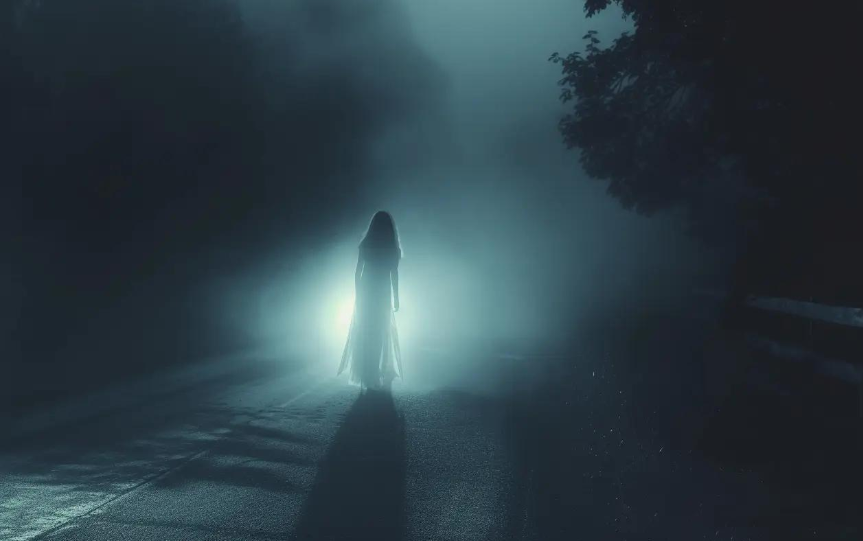
Then your headlights illuminate someone walking along the shoulder.
You slow down.
The person doesn’t react.
You pass them.
A few seconds later, you look in the rearview mirror.
Nothing.
You turn around.
The road is empty.
Stories like this have appeared in many forms. Sometimes the mysterious pedestrian is described as an elderly person. Sometimes a woman in old-fashioned clothing. Sometimes a man carrying something that resembles a suitcase.
The strangest detail is often the same:
The figure seems completely unaware of the living person watching them.
Step-by-Step: How a Ghostly Encounter Might Unfold
If you’re writing or imagining a classic “dead ghost walking” encounter, the tension often develops gradually rather than beginning with a dramatic appearance.
Step 1: Establish an Ordinary Setting
Start somewhere familiar.
A quiet neighborhood.
An old road.
A train station.
A rural pathway.
An apartment hallway.
The more ordinary the location feels, the more disturbing the supernatural event becomes.


10
Step 2: Introduce Something Slightly Unusual
Don’t reveal the ghost immediately.
Perhaps the character hears footsteps.
Maybe a light turns on in an abandoned house.
Perhaps there is a person standing unusually far away.
The character notices something—but can’t immediately explain it.
That uncertainty creates suspense.
Step 3: Let the Figure Begin Walking
Now comes the moment when the story earns its title.
The figure begins moving.
Slowly.
Silently.
Perhaps their clothes look strangely old.
Perhaps they walk directly toward the character.
Or perhaps they walk in the opposite direction, following a path that seems familiar to them.


13
Step 4: Create the Impossible Detail
Every memorable supernatural story needs one detail that doesn’t make sense.
The character recognizes the figure.
The figure has no reflection.
The footsteps continue after the figure disappears.
The person leaves footprints—but they stop suddenly.
Or perhaps someone else arrives and says:
“You saw him too?”
That single sentence can completely change the story.
Step 5: Reveal the History
Eventually, the character discovers something about the mysterious walker.
Maybe the person died decades ago.
Maybe the road was once the site of an accident.
Maybe an old photograph contains the same face.
Or perhaps the figure was once someone who lived in the house nearby.


8
The discovery transforms a strange encounter into a mystery.
The Ghost Who Followed the Same Route
One of the most unsettling ideas in ghost folklore is that some spirits may be connected to a specific journey.
Imagine an old railway worker who walked home along the same route every evening.
One night, an accident occurs.
Years later, residents begin reporting a person walking beside the abandoned railway line.
The figure never speaks.
He never approaches anyone.
He simply walks.
Always in the same direction.
Always around the same time.
And always disappears before reaching the old station.


13
Perhaps the story is nothing more than folklore.
Perhaps there is another explanation.
But the repetition is what makes it disturbing.
The ghost isn’t wandering randomly.
It seems to be remembering.
Why Walking Ghosts Feel More Frightening
A stationary ghost is frightening.
A walking ghost is different.
Movement creates anticipation.
If something is standing in a dark doorway, you can choose not to approach it.
But when something is walking toward you, the situation changes.
You have to decide whether to run.
You have to wonder where it is going.
You have to ask yourself whether it can see you.
And most importantly:
What happens when it reaches you?
This uncertainty is one reason walking figures appear so frequently in horror stories.
The Psychology Behind Seeing Ghosts
Not every ghost sighting requires a supernatural explanation.
Human perception can be surprisingly unreliable, especially under stress, darkness, fatigue, or fear.
A distant tree can look like a person.
A moving shadow can resemble someone walking.
A reflection can appear to be another individual.
Sleep deprivation can also affect perception and memory.
There is another fascinating phenomenon known as pareidolia, where the brain recognizes familiar shapes—especially faces or human forms—in ambiguous visual information.
This doesn’t mean every ghost story is false.
It simply reminds us that there can be multiple explanations for an unexplained experience.
And sometimes, not knowing which explanation is correct is what makes the story so compelling.
Step-by-Step: Creating a Truly Chilling Ghost Story
If you’re creating your own paranormal story, subtlety is often more effective than constant scares.
1. Begin With Normal Life
Give the reader something familiar.
A person returning home from work.
Someone walking their dog.
A night-shift employee leaving a building.
A driver taking a shortcut.
Then introduce the unexplained event.
2. Use Silence
Silence can be more frightening than screaming.
Describe what the character doesn’t hear.
No insects.
No traffic.
No wind.
Only footsteps.
3. Avoid Showing Everything
Keep the ghost partially hidden.
A silhouette.
A coat.
A pair of shoes.
A face seen for only a second.
The reader’s imagination can often create something more frightening than a detailed description.
4. Add a Historical Mystery
Give the location a secret.
An old disappearance.
A forgotten accident.
A missing person.
A house that has been empty for decades.
This gives the supernatural event emotional weight.
5. End With a Twist
The best ghost stories don’t necessarily explain everything.
Sometimes the final discovery creates an even bigger question.
A Ghost Doesn’t Always Need to Be Evil
An important part of supernatural storytelling is remembering that a ghost doesn’t necessarily have to be a villain.
Some ghost stories describe spirits as lonely.
Others portray them as confused.
Some appear to be protecting someone.
Others simply seem trapped in a repeated moment.
That makes the concept of dead ghosts walking more emotional than frightening.
Imagine encountering someone who has been gone for fifty years—but still walks the same road because they never realized their journey had ended.
That isn’t just scary.
It’s tragic.
The Most Unsettling Question
Perhaps the most disturbing question isn’t:
“Do ghosts exist?”
It’s this:
“If they did exist, would they know that they’re dead?”
What if some spirits don’t recognize the living?
What if they don’t know that decades have passed?
What if they continue walking because walking is all they remember?
And what if, occasionally, a living person happens to cross their path?
These questions sit at the heart of many ghost stories.
When the Walking Stops


11
The most memorable supernatural encounters often end quietly.
The footsteps stop.
The figure disappears.
The lights return to normal.
The character reaches home.
Everything appears ordinary again.
But something has changed.
The character now knows that the world contains mysteries that may never have simple explanations.
Maybe the figure was a ghost.
Maybe it was a trick of the light.
Maybe fear transformed an ordinary person into something impossible.
Or maybe—just maybe—the dead really do continue walking among the living.
Final Thoughts on Dead Ghosts Walking
Stories about walking ghosts have survived for generations because they touch something deeply human.
We are fascinated by death.
We fear what comes after it.
And we wonder whether the people we lose simply disappear—or whether some part of them remains behind.
Dead ghosts walking is ultimately more than a frightening idea. It is a story about unfinished journeys, forgotten memories, mysterious places, and the thin boundary between what we understand and what we don’t.
The next time you walk alone at night and hear footsteps behind you, don’t panic.
Stop.
Listen.
If the footsteps stop too, perhaps it was nothing.
But if they continue…
you may want to turn around.
Just once.
And remember:
Not every person you see walking at night is necessarily alive.