Introduction
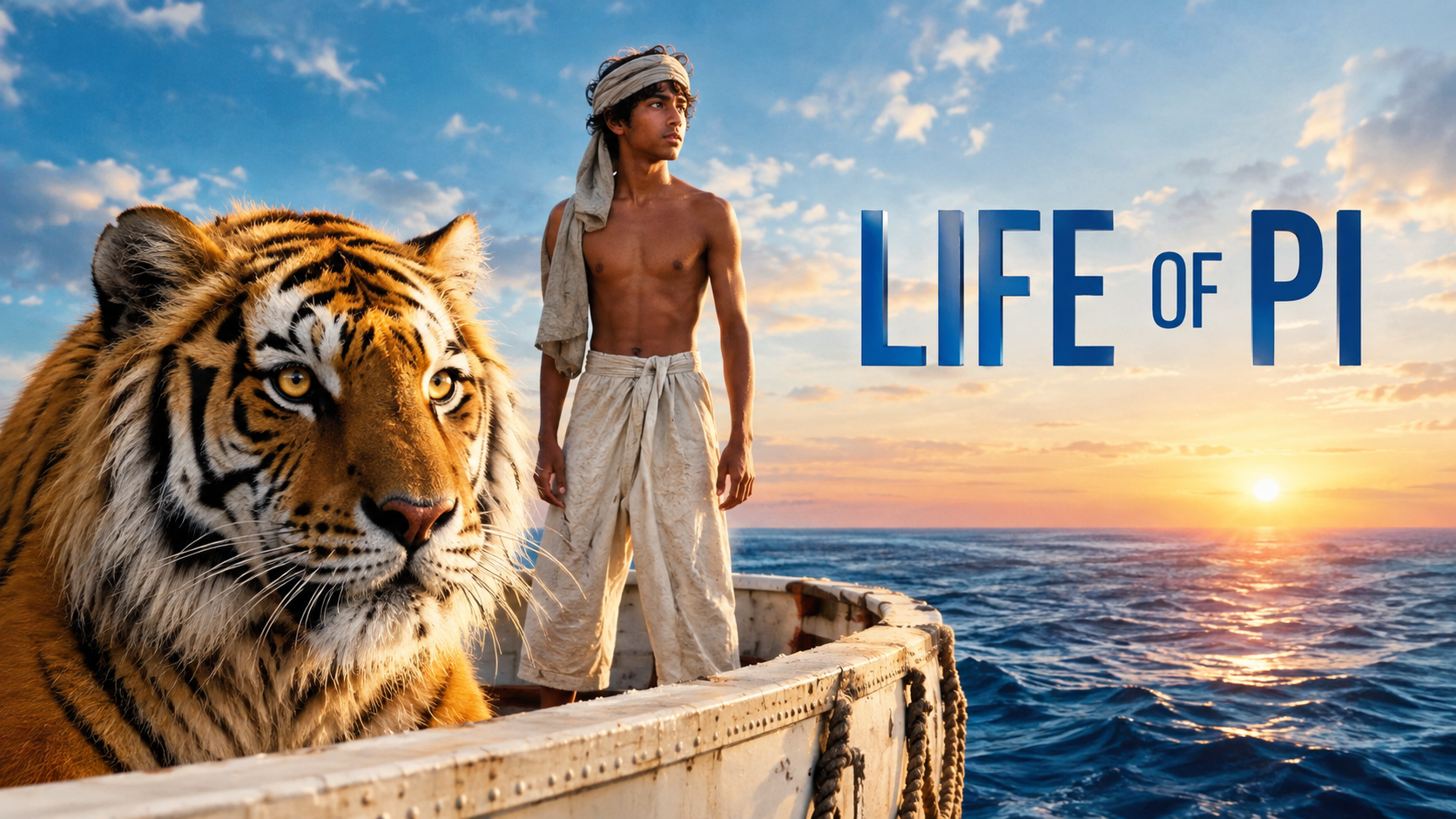
What would happen if a teenager were suddenly left alone in the middle of the Pacific Ocean with almost no food, no land in sight, and a Bengal tiger sharing his lifeboat?
That extraordinary question lies at the heart of Yann Martel’s Life of Pi, a story that combines adventure, survival, spirituality, grief, imagination, and one of literature’s most memorable relationships between a human being and a wild animal.
The story follows Piscine Molitor Patel, usually called Pi, a boy from Pondicherry, India. His father manages a zoo, and Pi grows up surrounded by animals while developing an unusually deep interest in religion. As a teenager, he becomes fascinated by Hinduism, Christianity, and Islam, finding something meaningful in each.
Eventually, Pi’s family decides to leave India for Canada. They board a Japanese cargo ship carrying many of their zoo animals.
The journey changes Pi’s life forever.
The ship sinks, his family disappears, and Pi finds himself on a small lifeboat with several animals—including Richard Parker, a Bengal tiger.
What follows is an extraordinary battle to remain alive.
Part One: Pi Patel’s Extraordinary Childhood
Growing Up in a Zoo
Pi is born Piscine Molitor Patel and grows up in Pondicherry, India.
His father runs a zoo, so animals are not unusual visitors in Pi’s childhood. They are part of his everyday world.
Rather than seeing the zoo simply as a collection of cages, Pi becomes fascinated by animal behavior. His experiences teach him that animals are neither harmless companions nor human-like creatures. They have instincts, territories, fears, and survival mechanisms.
His father makes this lesson painfully clear when Pi and his brother are shown the danger of a Bengal tiger.
The experience stays with Pi.
He learns that respecting a wild animal means understanding what it is—not pretending it shares human emotions or moral rules.
Pi and His Search for God
Pi’s relationship with religion becomes one of the most important parts of his personality.
He begins as a Hindu and later becomes interested in Christianity. Eventually, he also discovers Islam.
Instead of choosing one tradition and rejecting the others, Pi tries to understand them all.
To him, faith is about reaching toward something greater than himself.
His unusual approach sometimes confuses the adults around him. Yet Pi sees no contradiction in wanting to learn from different religious traditions.
This spiritual curiosity becomes extremely important later because his survival at sea will test everything he believes.
The Patel Family Leaves India
Political uncertainty eventually affects Pi’s family.
His father decides that the family should leave India and begin a new life in Canada.
The zoo will close, and many of the animals will be transported to new homes.
Pi, his parents, and his brother Ravi board a Japanese cargo ship called the Tsimtsum.
The vessel carries the Patel family, crew members, supplies, and animals from the zoo.
For Pi, the voyage represents the beginning of a new chapter.
He expects to leave his childhood behind and start again in Canada.
He has no idea that the ocean is about to become the most important place of his life.
The Shipwreck
A Night of Terror
The journey does not last.
During the voyage, something goes terribly wrong.
The ship sinks.
Pi is thrown into the chaos of the disaster. Water surrounds him, people disappear, and the vessel that carried his family is swallowed by the ocean.
In the confusion, Pi reaches a lifeboat.
For a brief moment, survival seems possible.
Then he realizes that he is not alone.
A wounded zebra is there.
A hyena is there.
An orangutan named Orange Juice is there.
And somewhere beneath the lifeboat’s protective covering is something far more dangerous.
Richard Parker.
Richard Parker Appears
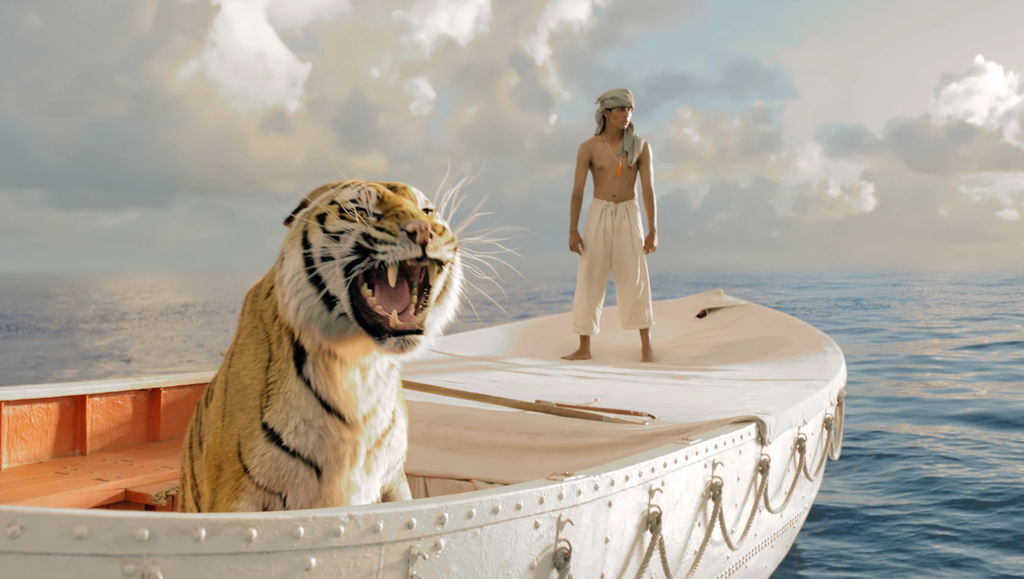
Pi soon discovers that a Bengal tiger is also aboard the lifeboat.
His name is Richard Parker.
At first, Pi’s greatest fear is the tiger.
But the other animals create their own deadly struggle.
The hyena becomes aggressive and attacks the weaker animals. The situation rapidly becomes more violent.
Eventually, Richard Parker emerges.
The tiger kills the hyena.
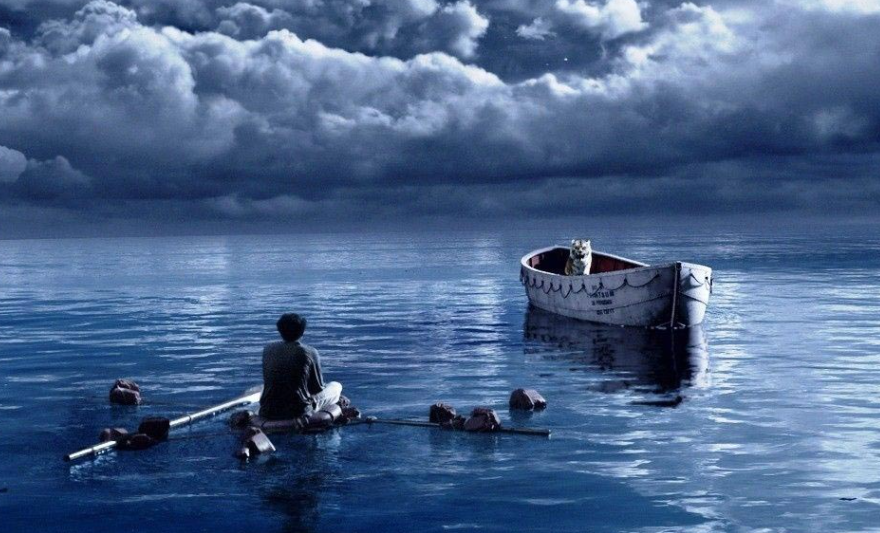
Pi is now completely alone with a predator capable of killing him at any moment.
Yet Richard Parker is not simply an enemy.
He is also the strange companion who will keep Pi focused on survival.
Pi Learns to Survive
Food and Water
Pi quickly realizes that fear alone will not keep him alive.
He needs a system.
He searches the lifeboat and discovers emergency supplies.
Water becomes especially important.
Food is limited.
The ocean offers fish and other potential sources of nourishment, but catching them is difficult and sometimes dangerous.
Pi begins developing practical survival skills.
He learns how to collect rainwater.
He learns how to fish.
He protects his supplies.
He studies the weather.
He keeps track of the passing days.
And most importantly, he begins figuring out how to live beside Richard Parker.
The Strange Relationship Between Pi and Richard Parker
Pi knows that he cannot simply become friends with a tiger.
Richard Parker is still a wild animal.
Instead, Pi tries to establish boundaries.
He uses food, signals, movement, and conditioning to teach the tiger that the lifeboat has an order.
The tiger learns that certain areas belong to Pi.
Pi learns when to stay away.
Their relationship becomes a fragile arrangement based on survival.
This is one of the most fascinating parts of the story.
Pi needs Richard Parker to remain alive—but he also needs to remain alive because of Richard Parker.
The tiger gives Pi a reason to stay alert.
Every day requires attention.
Every mistake could be fatal.
227 Days in the Pacific
The days become weeks.
The weeks become months.
Pi’s world becomes unbelievably small.
There is the lifeboat.
There is the ocean.
There is the sky.
There is Richard Parker.
And there is Pi’s determination to continue.
The story emphasizes how survival is not one heroic moment. It is thousands of small decisions repeated day after day.
Pi has to deal with hunger, thirst, exhaustion, storms, loneliness, injuries, heat, cold, and fear.
At times, he nearly loses hope.
But routine gives him something to hold onto.
He maintains his responsibilities.
He feeds himself.
He manages the tiger.
He watches the weather.
He prays.
He survives.
Pi’s Faith Is Tested
The physical struggle is only one part of Pi’s ordeal.
His spiritual beliefs are tested as well.
Before the shipwreck, Pi could explore religion from the safety of everyday life.
Now he must confront death directly.
He loses his family.
He faces hunger.
He watches nature behave without mercy.
He experiences moments when rescue seems impossible.
Yet he continues to pray and search for meaning.
For Pi, faith does not magically remove suffering.
Instead, it becomes one of the ways he continues moving forward.
The Storm
The ocean eventually produces another terrifying challenge.
A violent storm strikes the lifeboat.
The waves become enormous.
The boat is tossed around.
Pi struggles to protect himself and Richard Parker.
The storm reminds him just how powerless a human being can be against nature.
Afterward, the ocean becomes strangely calm again.
Pi survives another day.
But the experience leaves him exhausted.
Pi Encounters Another Survivor
At one of his lowest points, Pi becomes severely weakened and temporarily loses his sight.
Then he hears another human voice.
Another castaway has survived somewhere nearby.
For Pi, the discovery is almost unbelievable.
Finally, he may not be alone.
But the meeting does not bring the comfort he hoped for.
The other survivor is desperate and dangerous.
The encounter ends tragically, reinforcing one of the story’s darkest ideas:
Survival can push human beings toward terrifying choices.
Pi survives the encounter, but the emotional cost is enormous.
The Mysterious Island
A Beautiful Place That Isn’t Safe
After months at sea, Pi discovers something extraordinary.
He finds a strange floating island covered with vegetation and populated by enormous numbers of meerkats.
At first, the island appears to be a miracle.
Pi and Richard Parker can rest.
There is food.
There is water.
There is shelter.
After everything Pi has endured, the island seems like the answer to his prayers.
But Pi is observant.
Something about the island feels wrong.
The Island’s Terrifying Secret
Pi eventually discovers evidence that the island is dangerous.
The vegetation behaves in a way that reveals a deadly side of the ecosystem.
The island is not the paradise it first appeared to be.
Pi realizes that staying there permanently could cost him his life.
So he makes a difficult decision.
He leaves.
It is another example of Pi choosing uncertainty over false security.
He returns to the lifeboat.
Richard Parker goes with him.
Reaching Mexico
Eventually, after 227 days at sea, Pi’s lifeboat reaches the coast of Mexico. The Booker Prize’s official summary likewise records Pi’s 227-day ordeal before rescue.
Pi is weak, exhausted, and almost unrecognizable from the boy who originally boarded the ship.
He has lost his family.
He has endured unimaginable suffering.
But he is alive.
Richard Parker climbs out of the boat.
For Pi, this should be the emotional ending he has been waiting for.
Instead, something happens that hurts him deeply.
Richard Parker walks away.
Richard Parker Never Says Goodbye
Pi watches the tiger disappear into the jungle.
He desperately wishes Richard Parker would turn around.
He wants some acknowledgment of everything they experienced together.
But Richard Parker does not understand their relationship in the human sense.
He is a tiger.
He walks away.
Pi is devastated.
The animal that helped keep him alive leaves without a farewell.
This moment is painful because Pi had developed an emotional connection to Richard Parker that the tiger could never express in the same way.
Pi’s New Life
Pi is eventually taken to safety.
He receives medical attention and begins rebuilding his life.
Later, he settles in Canada.
He marries and has a family.
The terrible journey remains part of him, but it does not completely define his future.
Pi has survived.
He has grown older.
And he continues to carry questions about what happened.
The Two Versions of the Story
What Really Happened?
One of the most important parts of Life of Pi comes near the end.
Pi tells investigators about his journey.
They are skeptical.
Some parts of his account sound impossible.
A teenager surviving for 227 days with a Bengal tiger is extraordinary enough.
A mysterious carnivorous island sounds even harder to believe.
The investigators want a version of events that makes more conventional sense.
So Pi gives them another story.
It is darker.
It contains no magical island.
It removes the animals.
Instead, human beings take the place of the animals.
The details force the listener—and the reader—to reconsider everything that came before.
The Meaning Behind the Two Stories
The story does not simply ask, “Which version is true?”
Instead, it asks a deeper question:
Which story allows us to understand suffering and survival?
The animal version is extraordinary and almost mythological.
The alternative version is much more brutal and disturbing.
Richard Parker can therefore be understood in several ways.
He may simply be a tiger.
He may also represent the part of Pi that became capable of doing whatever was necessary to survive.
The beauty of the story is that it does not force readers into one simple interpretation.
What Happened to Pi’s Family?
Pi never truly escapes the emotional consequences of the shipwreck.
His parents and brother are gone.
The loss shapes the person he becomes.
His survival is therefore not a conventional happy ending.
Pi survives, but survival comes with grief.
That distinction is essential to understanding the story.
The Real Meaning of Richard Parker
Richard Parker is much more than an animal companion.
He represents fear.
He represents nature.
He represents instinct.
He represents responsibility.
And, perhaps most importantly, he gives Pi a reason to continue.
Pi cannot simply surrender because there is another living creature depending on him.
The tiger forces Pi to maintain discipline.
In an unexpected way, the creature he fears most becomes one of the reasons he survives.
Major Themes in Life of Pi
1. Survival
The most obvious theme is survival.
Pi survives not through one miraculous act, but through patience, intelligence, preparation, discipline, and an unwillingness to give up.
2. Faith
Pi’s faith is challenged repeatedly.
The story explores whether belief can help someone endure suffering even when there are no easy answers.
3. Storytelling
Perhaps the most important theme is storytelling itself.
Pi presents two versions of his experience and leaves the audience to consider why humans tell stories.
A story can give meaning to something that otherwise seems unbearable.
4. Human Nature
The novel asks what happens to people when civilization disappears.
Without society, laws, food systems, family structures, and safety, what remains?
Pi’s ordeal explores that question in disturbing ways.
5. The Relationship Between Humans and Nature
Pi’s relationship with Richard Parker is never truly a friendship in the conventional sense.
It is a relationship between two living creatures struggling to survive.
That makes it more fascinating—and more realistic.
Why Life of Pi Remains So Powerful
Life of Pi works because it can be read at several levels.
On the surface, it is a survival adventure.
Underneath that, it is a story about grief.
It is also a philosophical exploration of faith, truth, memory, and storytelling.
The novel won the 2002 Booker Prize, and the official Booker Prize description highlights its combination of invention, philosophical ideas, and playful storytelling.
The story later became a major film directed by Ang Lee. The 2012 movie stars Suraj Sharma as Pi and presents the central survival story of a young survivor stranded in a lifeboat with Richard Parker.
Life of Pi Ending Explained
The ending is deliberately open to interpretation.
Pi survives.
Richard Parker disappears.
Pi eventually builds a new life.
But the two versions of his survival story remain.
The audience is left with an important choice.
Do you believe the extraordinary story involving animals?
Or do you believe the darker human version?
There may not be a completely satisfying factual answer.
And that is precisely the point.
Pi asks us to consider what we want from a story.
Do we want a cold explanation of terrible events?
Or do we sometimes need a story that allows us to find meaning, beauty, faith, and hope inside suffering?
Final Thoughts: The Life of Pi Story
Life of Pi begins with a boy who loves animals and searches for God.
It becomes the story of a teenager who loses almost everything.
Pi crosses an ocean with hunger, fear, loneliness, and death surrounding him.
Yet he continues.
He learns.
He adapts.
He prays.
He fights.
And eventually, he reaches land.
But his greatest achievement is not simply surviving 227 days at sea.
It is finding a way to live after surviving something that should have destroyed him.
Richard Parker disappears into the jungle, but the tiger remains an unforgettable part of Pi’s story.
And perhaps that is the final lesson of Life of Pi:
Sometimes survival is not about defeating fear. It is about learning how to live beside it.
Pi’s journey leaves us with a question that has no easy answer—but perhaps that is exactly why the story stays with us long after it ends.